Advertisements
Advertisements
Question
From the rate expression for the following reaction, determine the order of reaction and the dimension of the rate constant.
\[\ce{C2H5Cl_{(g)} -> C2H4_{(g)} + HCl_{(g)}}\] Rate = k[C2H5Cl]
Advertisements
Solution
Given rate = k[C2H5Cl]
∴ Order of the reaction = 1
Dimension of k = \[\ce{\frac{Rate}{[C2H5Cl]}}\]
= \[\ce{\frac{(mol L^{-1} s^{-1})}{mol L^{-1}}}\]
= s−1
APPEARS IN
RELATED QUESTIONS
Define “zero order reaction”.
A reaction is second order in A and first order in B.
(i) Write the differential rate equation.
(ii) How is the rate affected on increasing the concentration of A three times?
(iii) How is the rate affected when the concentrations of both A and B are doubled?
What is pseudo first order reaction? Give one· example of it.
For a reaction: 
Rate = k
(i) Write the order and molecularity of this reaction.
(ii) Write the unit of k.
For a reaction A + B ⟶ P, the rate is given by
Rate = k [A] [B]2
How is the rate of reaction affected if the concentration of B is doubled?
For a reaction A + B ⟶ P, the rate is given by
Rate = k [A] [B]2
What is the overall order of reaction if A is present in large excess?
For a reaction : 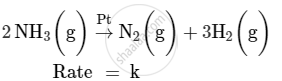
(i) Write the order and molecularity of this reaction.
(ii) Write the unit of k.
A reaction is first order in A and second order in B. How is the rate affected when the concentrations of both A and B are doubled?
In a reaction between A and B, the initial rate of reaction (r0) was measured for different initial concentrations of A and B as given below:
| A/mol L−1 | 0.20 | 0.20 | 0.40 |
| B/mol L−1 | 0.30 | 0.10 | 0.05 |
| r0/mol L−1 s−1 | 5.07 × 10⁻⁵ | 5.07 × 10⁻⁵ | 1.43 × 10⁻⁴ |
What is the order of the reaction with respect to A and B?
For a reaction R ---> P, half-life (t1/2) is observed to be independent of the initial concentration of reactants. What is the order of reaction?
Define the following terms:
Half-life period of reaction (t1/2).
For which type of reactions, order and molecularity have the same value?
Assertion: Rate constants determined from Arrhenius equation are fairly accurate for simple as well as complex molecules.
Reason: Reactant molecules undergo chemical change irrespective of their orientation during collision.
For a reaction \[\ce{Cl2l(g) + 2No(g) -> 2NaCl(g)}\] the rate law is expressed as rate= K[Cl2] [No]2 what is the order of the reaction?
For reaction 2A + B → BC + D which of the following does not Express the reaction rates
At concentration of 0.1 and 0.2 mol L–1 the rates of deem position of a compound were found to be 0.18 and 0.72 mol L–1 m–1. What is the order of the reaction?
On heating compound (A) gives a gas (B) which is constituent of air. The gas when treated with H2 in the presence of catalyst gives another gas (C) which is basic in nature, (A) should not be ______.
The following data was obtained for chemical reaction given below at 975 K.
\[\ce{2NO(g) + 2H2(g) -> N2(g) + 2H2O(g)}\]
| [NO] | [H2] | Rate | |
| Mol L-1 | Mol L-1 | Mol L-1 s-1 | |
| (1) | 8 × 10⁻⁵ | 8 × 10⁻⁵ | 7 × 10⁻⁹ |
| (2) | 24 × 10-5 | 8 × 10⁻⁵ | 2.1 × 10⁻⁸ |
| (3) | 24 × 10-5 | 32 × 10-5 | 8.4 × 10⁻⁸ |
The order of the reaction with respect to NO is ______. (Integer answer)
Which of the following statement is true?
A reaction is second order with respect to a reactant. How is the rate of reaction affected if the concentration of the reactant is reduced to half?
