Advertisements
Advertisements
Questions
A reaction is first order in A and second order in B. How is the rate affected when the concentrations of both A and B are doubled?
A reaction is of first order with respect to reactant [A] and second order with regard to reactant [B]. What is the effect on rate of reaction when concentrations of both [A] and [B] are doubled?
Advertisements
Solution
When the concentrations of both A and B are doubled,
Rate = k(2a) (2b)2
= k(2a) (4b2)
= 8 kab2
∴ The reaction rate will increase by a factor of 8.
APPEARS IN
RELATED QUESTIONS
A reaction is second order in A and first order in B.
(i) Write the differential rate equation.
(ii) How is the rate affected on increasing the concentration of A three times?
(iii) How is the rate affected when the concentrations of both A and B are doubled?
What is pseudo first order reaction? Give one· example of it.
For a reaction: 
Rate = k
(i) Write the order and molecularity of this reaction.
(ii) Write the unit of k.
For a reaction A + B ⟶ P, the rate is given by
Rate = k [A] [B]2
What is the overall order of reaction if A is present in large excess?
For a reaction : 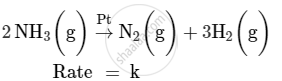
(i) Write the order and molecularity of this reaction.
(ii) Write the unit of k.
For a reaction, \[\ce{A + B -> Product}\]; the rate law is given by, r = k [A]1/2 [B]2. What is the order of the reaction?
Mention the factors that affect the rate of a chemical reaction.
A reaction is first order in A and second order in B. How is the rate affected on increasing the concentration of B three times?
Define the following terms:
Half-life period of reaction (t1/2).
Rate of reaction for the combustion of propane is equal to:
\[\ce{C3H8_{(g)} + 5O2_{(g)} -> 3CO2_{(g)} + 4H2O_{(g)}}\]
Why can’t molecularity of any reaction be equal to zero?
Assertion: Order and molecularity are same.
Reason: Order is determined experimentally and molecularity is the sum of the stoichiometric coefficient of rate determining elementary step.
For a reaction 1/2 A ⇒ 2B, rate of disappearance of A is related 't o the appearance of B by the expression:
The number of molecules of the reactants taking part in a single step of the reaction is indicative of ______.
Assertion (A): Order of reaction is applicable to elementary as well as complex reactions.
Reason (R): For a complex reaction, molecularity has no meaning.
Which of the following statement is true?
A reaction is second order with respect to a reactant. How is the rate of reaction affected if the concentration of the reactant is reduced to half?
Higher yield of NO in \[\ce{N2(g) + O2 <=> 2NO(g)}\] can be obtained at:
[ΔH of the reaction = +180.7 kJ mol−1]
- higher temperature
- lower temperature
- higher concentration of N2
- higher concentration of O2
Choose the correct answer from the options given below:
