Advertisements
Advertisements
Question
For a reaction : 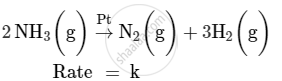
(i) Write the order and molecularity of this reaction.
(ii) Write the unit of k.
Advertisements
Solution
(i) This reaction is catalysed by Pt at high pressure. So, it is a zero-order reaction with molecularity 2.
(ii) The rate law expression for this reaction is
Rate = k
Hence, the unit of k is mol L−1 s−1.
APPEARS IN
RELATED QUESTIONS
A → B is a first order reaction with rate 6.6 × 10⁻⁵m-s-1. When [A] is 0.6m, rate constant of the reaction is
- 1.1 × 10⁻⁵s-1
- 1.1 × 10⁻⁴s-1
- 9 × 10⁻⁵s-1
- 9 × 10⁻⁴s-1
For a reaction A + B ⟶ P, the rate is given by
Rate = k [A] [B]2
What is the overall order of reaction if A is present in large excess?
Mention the factors that affect the rate of a chemical reaction.
How does calcination differ from roasting?
What is the order of a reaction which has a rate expression; Rate = `"k"["A"]^(3/2)["B"]^1`?
Why does the rate of any reaction generally decreases during the course of the reaction?
Assertion: Order of the reaction can be zero or fractional.
Reason: We cannot determine order from balanced chemical equation.
Assertion: The enthalpy of reaction remains constant in the presence of a catalyst.
Reason: A catalyst participating in the reaction, forms different activated complex and lowers down the activation energy but the difference in energy of reactant and product remains the same.
In the presence of a catalyst, the heat evolved or absorbed during the reaction.
The conversion of molecules A to B follow second order kinetics. If concentration of A is increased to three times, how will it affect the rate of formation of B?
