Advertisements
Advertisements
प्रश्न
For a reaction : 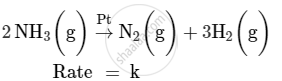
(i) Write the order and molecularity of this reaction.
(ii) Write the unit of k.
Advertisements
उत्तर
(i) This reaction is catalysed by Pt at high pressure. So, it is a zero-order reaction with molecularity 2.
(ii) The rate law expression for this reaction is
Rate = k
Hence, the unit of k is mol L−1 s−1.
APPEARS IN
संबंधित प्रश्न
From the rate expression for the following reaction, determine the order of reaction and the dimension of the rate constant.
\[\ce{CH3CHO_{(g)} -> CH4_{(g)} + CO_{(g)}}\] Rate = k[CH3CHO]3/2
A reaction is first order in A and second order in B. How is the rate affected on increasing the concentration of B three times?
In a reaction between A and B, the initial rate of reaction (r0) was measured for different initial concentrations of A and B as given below:
| A/mol L−1 | 0.20 | 0.20 | 0.40 |
| B/mol L−1 | 0.30 | 0.10 | 0.05 |
| r0/mol L−1 s−1 | 5.07 × 10⁻⁵ | 5.07 × 10⁻⁵ | 1.43 × 10⁻⁴ |
What is the order of the reaction with respect to A and B?
Define the following terms:
Half-life period of reaction (t1/2).
For which type of reactions, order and molecularity have the same value?
Use Molecular Orbital theory to determine the bond order in each of species, [He2j+ and [He2]2+?
In the presence of a catalyst, the heat evolved or absorbed during the reaction.
At concentration of 0.1 and 0.2 mol L–1 the rates of deem position of a compound were found to be 0.18 and 0.72 mol L–1 m–1. What is the order of the reaction?
Identify the order of reaction from the following unit for its rate constant:
L mol–1 s–1
A flask contains a mixture of compounds A and B. Both compounds decompose by first-order kinetics. The half-lives for A and B are 300 s and 180 s, respectively. If the concentrations of A and B are equal initially, the time required for the concentration of A to be four times that of B (in s) is ______. (Use ln 2 = 0.693)
