Advertisements
Advertisements
प्रश्न
Read the following passage and answer the questions that follow:
|
The rate of reaction is concerned with decrease in the concentration of reactants or increase in the concentration of products per unit of time. It can be expressed as instantaneous rate at a particular instant of time and average rate over a large interval of time. A number of factors such as temperature, concentration of reactants, catalyst affect the rate of reaction. Mathematical representation of rate of a reaction is given by rate law: Rate = k[A]x [B]y x and y indicate how sensitive the rate is to change in concentration of A and B. Sum of x + y gives the overall order of a reaction. |
- What is the effect of temperature on the rate constant of a reason? [1]
- For a reaction \[\ce{A + B → Product}\], the rate law is given by, Rate = k[A]2 [B]1/2. What is the order of the reaction? [1]
- How order and molecularity are different for complex reactions? [1]
- A first-order reaction has a rate constant 2 × 10⁻³ s–1. How long will 6 g of this reactant take to reduce to 2 g? [2]
OR
The half-life for radioactive decay of 14C is 6930 years. An archaeological artifact containing wood had only 75% of the 14C found in a living tree. Find the age of the sample.
[log 4 = 0.6021, log 3 = 0.4771, log 2 = 0.3010, log 10 = 1] [2]
Advertisements
उत्तर
a. The rate constant (k) for a reaction increases with an increase in temperature and becomes almost double with every 10° rise in temperature. This effect is expressed by the Arrhenius equation:
k = `Ae^(-E_a//RT)`
b. According to the equation, r = k[A]2[B]1/2
Order of the reaction = `2 + 1/2 = 5/2`
c. Order of reaction is defined as the sum of the powers of the molar concentration of the reaction species in the rate equation of the reaction. It is applicable to both elementary and complex reactions.
Molecularity of a reaction is defined as the total number of reacting species participating in an elementary reaction. It has no significance for complex reactions as applicable only to elementary reactions.
d. k = 2 × 10⁻³ s–1
t = `2.303/k log [R]_0/[R]`
t = `2.303/(2 xx 10^-3) log 6/2`
t = 1151.5 × 0.4771
t = 549.3 s
OR
According to first-order reaction,
Half-life (t1/2) = `0.693/k`
t1/2 = 6980 years
k = `0.693/6980`
However, the time taken can be calculated using the first-order rate of reaction when wood contains only 75% of 14C.
Initial concentration of C14, [R]0 = 100
Amount at time t s, [R] = 75
t = `2.303/k log [R]_0/([R])`
t = `2.303/(0.693/6980) log 100/75`
t = 2898 years
Thus, the age of the sample is approximately 2898 years.
APPEARS IN
संबंधित प्रश्न
For the first order thermal decomposition reaction, the following data were obtained:

Time / sec Totalpressure / atm
0 0.30
300 0.50
Calculate the rate constant
(Given: log 2 = 0.301, log3 = 0.4771, log 4 = 0.6021)
In a reaction between A and B, the initial rate of reaction (r0) was measured for different initial concentrations of A and B as given below:
| A/mol L−1 | 0.20 | 0.20 | 0.40 |
| B/mol L−1 | 0.30 | 0.10 | 0.05 |
| r0/mol L−1 s−1 | 5.07 × 10⁻⁵ | 5.07 × 10⁻⁵ | 1.43 × 10⁻⁴ |
What is the order of the reaction with respect to A and B?
For a reaction R ---> P, half-life (t1/2) is observed to be independent of the initial concentration of reactants. What is the order of reaction?
Write resonating structures of ozone.
For a general reaction A → B, plot of concentration of A vs time is given in figure. Answer the following question on the basis of this graph.
(i) What is the order of the reaction?
(ii) What is the slope of the curve?
(iii) What are the units of rate constant?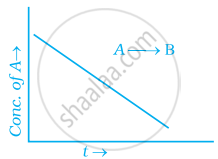
Why molecularity is applicable only for elementary reactions and order is applicable for elementary as well as complex reactions?
In the presence of a catalyst, the heat evolved or absorbed during the reaction.
For reaction 2A + B → BC + D which of the following does not Express the reaction rates
Identify the order of reaction from the following unit for its rate constant:
L mol–1 s–1
A flask contains a mixture of compounds A and B. Both compounds decompose by first-order kinetics. The half-lives for A and B are 300 s and 180 s, respectively. If the concentrations of A and B are equal initially, the time required for the concentration of A to be four times that of B (in s) is ______. (Use ln 2 = 0.693)
