Advertisements
Advertisements
Question
The time required for 10% completion of a first order reaction at 298 K is equal to that required for its 25% completion at 308 K. If the value of A is 4 × 10¹⁰ s−1. Calculate k at 318 K and Ea.
Advertisements
Solution
Let [R]0 = 100
t = `2.303/k_1 log 100/90 = 2.303/k_2 log 100/75`
⇒ `2.303/k_1 log 10/9 = 2.303/k_2 log 4/3`
⇒ `1/k_1 log 1.111 = 1/k_2 log 1.333`
⇒ `k_2/k_1 = (log 1.333)/(log 1.111)`
⇒ `k_2/k_1 = 0.1249/0.0457`
⇒ `k_2/k_1` = 2.733
⇒ `log k_2/k_1` = log 2.733 = 0.4367
`log k_2/k_1 = E_a/(2.303 R) ((T_2 - T_1)/(T_1T_2))`
⇒ 0.4367 = `E_a/(2.303 xx 8.314) ((308 - 298)/(298 xx 308))`
⇒ Ea = `(2.303 xx 8.314 xx 308 xx 298)/(10) xx 0.4367`
= `(19.147 xx 308 xx 298)/(10) xx 0.4367`
= 76743.13 J mol−1
⇒ Ea = `76743.13/1000`
= 76.74 kJ mol−1
log k = `log A - E_a/(2.303 RT)`
⇒ log k = `log (4 xx 10^10) - (76.74 xx 1000)/(2.303 xx 8.314 xx 318)`
⇒ log k = `10.6021 - 76740/6088.79`
⇒ log k = 10.6021 − 12.6034
⇒ log k = −2.0013
⇒ k = Antilog(−2.0013)
= Antilog(3.9987)
⇒ k = 9.97 × 10⁻³ s−1
Notes
The answer in the textbook is incorrect.
RELATED QUESTIONS
Time required to decompose SO2Cl2 to half of its initial amount is 60 minutes. If the decomposition is a first order reaction, calculate the rate constant of the reaction.
The following data were obtained during the first order thermal decomposition of SO2Cl2 at a constant volume.
\[\ce{SO2Cl2_{(g)} -> SO2_{(g)} + Cl2_{(g)}}\]
| Experiment | Time/s–1 | Total pressure/atm |
| 1 | 0 | 0.5 |
| 2 | 100 | 0.6 |
Calculate the rate of the reaction when total pressure is 0.65 atm.
For the decomposition of azoisopropane to hexane and nitrogen at 543 K, the following data are obtained.
| t (sec) | P(mm of Hg) |
| 0 | 35.0 |
| 360 | 54.0 |
| 720 | 63.0 |
Calculate the rate constant.
Which of the following graphs is correct for a first order reaction?


State a condition under which a bimolecular reaction is kinetically first order reaction.
With the help of an example explain what is meant by pseudo first order reaction.
In the first order reaction, half of the reaction is complete in 100 seconds. The time for 99% of the reaction to occurs will be
Observe the graph shown in figure and answer the following questions:
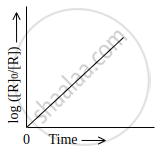
- What is the order of the reaction?
- What is the slope of the curve?
- Write the relationship between k and t1/2 (half life period).
For a first order reaction, the ratio of the time for 75% completion of a reaction to the time for 50% completion is ______. (Integer answer)
Radioactive decay follows first-order kinetics. The initial amount of two radioactive elements X and Y is 1 gm each. What will be the ratio of X and Y after two days if their half-lives are 12 hours and 16 hours respectively?
What is the rate constant?
Define first-order reaction.
The following data were obtained during the decomposition of SO2Cl2 at the constant volume. SO2Cl2 →SO2(g) + Cl2(g)
| Time (s) | Total Pressure (bar) |
| 0 | 0.5 |
| 100 | 0.6 |
Calculate the rate constant of the reaction.
Slove: \[\ce{2NOBr -> 2NO_{2(g)} + Br_{2(g)}}\]
For the above reaction, the rate law is rate = k[NOBr]2. If the rate of reaction is 6.5 × 10⁻⁶ mol L−1 s−1 at 2 × 10⁻³ mol L−1 concentration of NOBr, calculate the rate constant k for the reaction.
Write the equation for integrated rate law for a first order reaction.
Show that `t_(1/2)= 0.693/k` for first reaction.
Write the unit of rate constant [k] for the first order reaction.
If the half-life (t1/2) for a first order reaction is 1 minute, then the time required for 99.9% completion of the reaction is closest to ______.
