Advertisements
Advertisements
Question
Observe the graph shown in figure and answer the following questions:
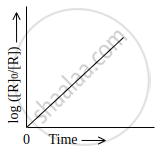
- What is the order of the reaction?
- What is the slope of the curve?
- Write the relationship between k and t1/2 (half life period).
Advertisements
Solution
- The order of the reaction is first-order reaction.
- Slope of the curve = `k/2.303`
- The half-life for the first-order reaction is given by t1/2 = `0.693/k`
APPEARS IN
RELATED QUESTIONS
Sucrose decomposes in acid solution into glucose and fructose according to the first order rate law with t1/2 = 3 hours. What fraction of the sample of sucrose remains after 8 hours?
Define order of reaction. How does order of a reaction differ from molecularity for a complex reaction?
With the help of an example explain what is meant by pseudo first order reaction.
In the presence of acid, the initial concentration of cane sugar was reduced from 0.2 M to 0.1 Min 5 hours and to 0.05 Min 10 hours. The reaction must be of?
In the first order reaction, half of the reaction is complete in 100 seconds. The time for 99% of the reaction to occurs will be
Time required to decompose SO2Cl2 to half of its initial concentration is 60 minutes. If the de-composite is a first order reaction, calculated the rate constant of the reaction-
Define first-order reaction.
Slove: \[\ce{2NOBr -> 2NO_{2(g)} + Br_{2(g)}}\]
For the above reaction, the rate law is rate = k[NOBr]2. If the rate of reaction is 6.5 × 10⁻⁶ mol L−1 s−1 at 2 × 10⁻³ mol L−1 concentration of NOBr, calculate the rate constant k for the reaction.
Write the equation for integrated rate law for a first order reaction.
If the half-life (t1/2) for a first order reaction is 1 minute, then the time required for 99.9% completion of the reaction is closest to ______.
