Advertisements
Advertisements
Question
Study the graph given below of a person who started from his home and returned at the end of the day. Answer the questions that follow.
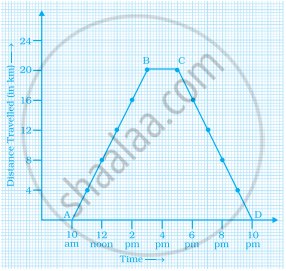
- At what time did the person start from his home?
- How much distance did he travel in the first four hours of his journey?
- What was he doing from 3 pm to 5 pm?
- What was the total distance travelled by him throughout the day?
- Calculate the distance covered by him in the first 8 hours of his journey.
- At what time did he cover 16 km of his journey?
- Calculate the average speed of the man from (a) A to B (b) B to C.
- At what time did he return home?
Advertisements
Solution
Observing the graph carefully, we conclude that
- At 10 AM, the person start from his home.
- In first 4 h (i.e. till 2 PM), he travelled 16 km.
- He was taking rest from 3 PM to 5 PM.
- The total distance covered by the person throughout the day was 40 km, i.e. 20 km from A to S and then 20 km from C to D.
- The distance covered by him in the first 8 h i.e. from 10 AM to 6 PM was 24 km.
- He covered 16 km of his journey at 2 PM.
- The total distance covered from A to S = 20 km and the time taken to travel from A to B = 5 h
∴ Average speed of the man from A to B = `20/5` = 4 km/h and average speed from S to C = `0/2` = 0 km/h - He returned home at 10 PM.
APPEARS IN
RELATED QUESTIONS
Plot the points (5, 0), (5, 1), (5, 8). Do they lie on a line? What is your observation?
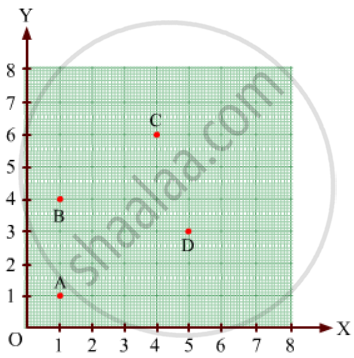
Find the coordinates of points A, B, C, D in Fig. 27.7.
Decide which of the following statement is true and which is false. Give reasons for your answer.
A point whose x-coordinate is zero, will lie on the y-axis.
In the coordinates of a point, the second number denotes the ______.
The points (3, 5) and (5, 3) represent the same point.
From the given graph, choose the letters that indicate the location of the points given below.
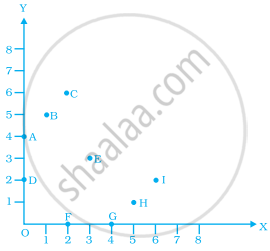
- (2, 0)
- (0, 4)
- (5, 1)
- (2, 6)
- (3, 3)
Make a line graph for the area of a square as per the given table.
| Side (in cm) | 1 | 2 | 3 | 4 |
| Area (in cm2) | 1 | 4 | 9 | 16 |
Is it a linear graph?
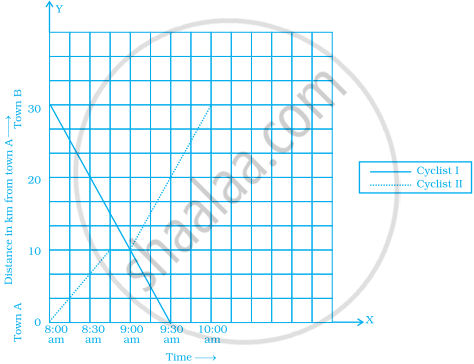
The following graph shows the journey made by two cyclists, one from town A to B and the other from town B to A.
- At what time did cyclist II rest? How long did the cyclist rest?
- Was cyclist II cycling faster or slower after the rest?
- At what time did the two cyclists meet?
- How far had cyclist II travelled when he met cyclist I?
- When cyclist II reached town A, how far was cyclist I from town B?
Observe the given graph carefully and complete the table given below.
| x | 1 | 2 | 3 | 4 | 5 |
| y |