Advertisements
Advertisements
Question
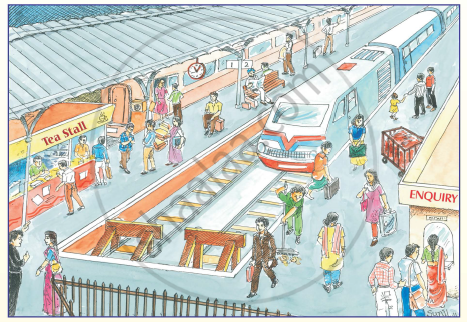
Study the following picture carefully and then write a paragraph to describe what is happening.
Advertisements
Solution
I find it interesting to describe the picture given above. It is the scene of the railway platform. The train has arrived some moments before at the platform. Some passengers are loading their luggage or belongings. Coolies are seen carrying goods to and fro on the platform. There are stalls selling various things needed by the passengers. Many passengers are walking to and fro to find the platform they are to go to. Some passengers are sipping tea while others are reading newspapers. Some are before the ‘Enquiry’ seeking information about the train they are to travel in. I hear the noise and hustle and bustle of a typical railway station platform. Some rehriwalas are serving purees and vegetables. The train which is about to leave the station seems to be starting to go. On the other platform passengers are waiting for their train to come. The railway platform is giving out a typical presentation of real India.
APPEARS IN
RELATED QUESTIONS
Now compare your answers with those of your partner and discuss the
following questions and write your observations in the given space.
a. Is the time referred to in the sentences always the same as the tense of
the verb? What conclusion can you draw from your observation? Write
your observation below.
...............................................................................................................................................
..................................................................................................................................................
b. How have you found the tense of the verbs in the sentences above? Are
there any indicators or markers that reveal the tense of the verb? Write
your observation below.
...............................................................................................................................................
..................................................................................................................................................
c. Did you find any verb form that could be called 'future form'? (You will
learn more about the different ways of talking about future later in this
unit.)
...............................................................................................................................................
..................................................................................................................................................
d. Why do you think verb forms are often labelled as 'simple' or 'indefinite', 'progressive' or 'continuous', 'perfect' and 'perfect continuous'?
...............................................................................................................................................
..................................................................................................................................................
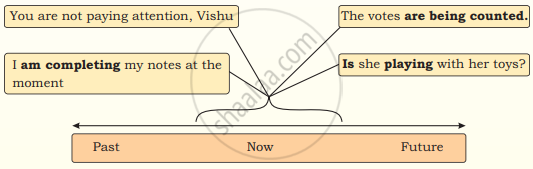
- S + is/am/are + verb + ing
- S + is/am/are + not + verb + ing.
- Is/am/are + S + verb + ing?
- S + is/am/are + being + Verb (past participle)
Complete the following sentences with the appropriate forms of the given verbs.
1. Every day I(go) to school in a bus but today I (go) by car because the bus operators are on strike.
2. "Baichung Bhutia (pass) the ball to Bannerjee; Bannerjee (take) a shot at the goal but it (be) way above the goal post. The Indians (attack) much more now ... "
3. I (think) you (make) a mistake by signing this contract.
4. The doctor (say) mother (respond) to the treatment well.
5. Farzana (be) not well. She (not come) to school today.
What has been the situation of your village/town/city five to ten years ago and how has it changed since then? Write a short paragraph describing the changes in its size, population, traftlc, buildings, lifestyle etc. Which verb forms would you mainly use to describe the changes? (Hint: Simple Past and Present Perfect forms.)
Now write short paragraphs to describe the trends in the other groups of visitors featured in the graph.
• Overseas Visitors
....................................................
....................................................
• Domestic Visitors
....................................................
....................................................
• Total Number ofVisitors
....................................................
....................................................
Tenses -Summary
Read the biodata of Sangeeta Rani Puri, India's swimming sensation. Then, complete the interview in the spaces provided. Do NOT add any extra information. Use appropriate tenses.
|
Natne : Sangeeta Rani Puri Status : Non-resident Indian Place of Birth : Trinidad Place of Residence : USA Parents : Raj Krishna Puri (Father) -fatnous immigration lawyer Moyna Margaret Puri (mother) - (from Trinidad) Achievements records : i) six new national records in five day (Junior National Swimming Meet, Vijaywada) |
Interviewer: Sangeeta, since you were in India for only a short while before
you flew to Atlanta, would you tell us a little about yourself?
Sangeeta : Well, I'm an Indian and I'm proud to be one.
I: Please tell us about your parents.
S: My father ____________________
_______________________ from Trinidad.
I: Have you taken part in any of the National Championships?
S: (Very excited) Yes,_________at Vijaywada.
I: How ______________________________________________ Senior Nationals?
S: I won seven events and __________
I: How do you rate your performance in the Altanta Olympics in 1996?
S: I ___________________________ in the 50 metres freestyle. It's true that I _____________in Atlanta. But _____________________
I: Haveyou ___________________ forthefuture?
S: I in the USA. And of course I ____________for as long as possible. Also I _______________________ in the olympics.
I: Thank you, Sangeeta. I wish you all the best.
S: Thankyouverymuch.
Work with apartner
In the following sentences, choose and circle the verb form you think best fits the meaning of each sentence. You have been provided an example.
| 1. Tomorrow | is will be is going to be | Wednesday. |
| 2. The train | has left will have left is going to leave | by the time you reach the station. |
| 3. Hurry! The film | does will is about to | start. |
| 4. The Minister | opens is opening is about to open | the new Art Centrenext week. |
| 5. This time next year, he | will live is living will be living | in Mumbai. |
| 6. I | am going to be will be will have been | a nurse when I grow up |
Use the correct tense form of the verb given in the bracket and rewrite the sentence.
She ________ at her left shoulder for quite some time.
Use the correct tense form of the verb given in the bracket and rewrite the sentence.
All this ________ destroyed in a few years.
Name the Tense of the Verb underlined to include Time (Past/Present/Future) and Aspect (Simple/Continuous/Perfect/Perfect Continuous).
I have been facing death.
Change the Tense as instructed.
The dots will somehow connect. (Past Perfect)
Underline the verb and choose the correct option from the options.
Preeti even wrote about it.
(present tense/past tense)
Underline the verb and choose the correct option from the options.
Rahul finds Maths easy.
(present tense/past tense)
Read the following sentence carefully, underline the verb and find out the tense in the sentence.
Still they took no notice of him.
Read the following sentence carefully, underline the verb and find out the tense in the sentence.
He leaned out eagerly.
Frame sentences using the homograph to show the difference in their meanings:
Train
