English

Work with Apartner in the Following Sentences, Choose and Circle the Verb Form You Think Best Fits the Meaning of Each Sentence. You Have Been Provided an Example.

Advertisements
Advertisements

Question

Work with apartner
In the following sentences, choose and circle the verb form you think best fits the meaning of each sentence. You have been provided an example.

1. Tomorrow is will be is going to be Wednesday.
2. The train has left will have left is going to leave by the time you reach the station.
3. Hurry! The film does will is about to start.
4. The Minister opens is opening is about to open the new Art Centrenext week.
5. This time next year, he will live is living will be living in Mumbai.
6. I am going to be will be will have been a nurse when I grow up
Answer in Brief
Advertisements

Solution

1. Tomorrow is will be is going to be Wednesday.
2. The train has left will have left is going to leave by the time you reach the station.
3. Hurry! The film does will is about to start.
4. The Minister opens is opening is about to open the new Art Centrenext week.
5. This time next year, he will live is living will be living in Mumbai.
6. I am going to be will be will have been a nurse when I grow up


shaalaa.com
Tense
  Is there an error in this question or solution?
Chapter 2: Tenses (Integrated Grammar practice 1) - Exercise F [Page 30]

APPEARS IN

CBSE English Workbook Class 10
Chapter 2 Tenses (Integrated Grammar practice 1)
Exercise F | Q 1 | Page 30

RELATED QUESTIONS

Now compare your answers with those of your partner and discuss the
following questions and write your observations in the given space.

a.  Is the time referred to in the sentences always the same as the tense of
the verb? What conclusion can you draw from your observation? Write
your observation below.

...............................................................................................................................................

..................................................................................................................................................

b.  How have you found the tense of the verbs in the sentences above? Are
there any indicators or markers that reveal the tense of the verb? Write
your observation below.

...............................................................................................................................................

..................................................................................................................................................

c.  Did you find any verb form that could be called 'future form'? (You will
learn more about the different ways of talking about future later in this
unit.)

...............................................................................................................................................

..................................................................................................................................................

d.  Why do you think verb forms are often labelled as 'simple' or 'indefinite', 'progressive' or 'continuous', 'perfect' and 'perfect continuous'?

...............................................................................................................................................

..................................................................................................................................................


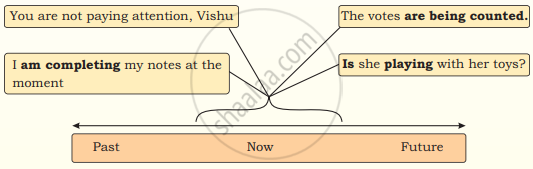
Present Progressive 

(Progressive = continuous)

Form

S +is/ am/ are +verb+ ing

S +is/ am/ are+ not+ verb+ ing.

Is/am/me+ S + verb+ing?

S + is/ am/ are +being+ Verb (past participle)

  • Complete the following sentences by filling in the blanks with the present progressive form of the given verbs.

i. "You've put on weight, Cheryl."
"Yes. I.. .... (eat) a lot these days."

ii. "Hurry up! We ... (get) late for school."
"Justa second, please! I ... (come}."

iii. Temperatures ... (rise} all over the world.

iv. "You .... not ... (wear) this dirty shirt to office. Wait, I'll give you another."

v. "l...not ... (do) your homework-forget it. I still haven't forgotten how you
fought with me in the morning."

vi. The Prime Minister ... (leave) for Russia tomorrow on a 5 day state visit.

Vii "You ... (be) ver:yrude, Abhi."

viii. She ... always (make) excuses for coming late.

ix. Aabha ... (write) a novel these days.

  • The table below shows different uses or meanings of the present progressive. Match the verbs in the above sentences with the uses or meanings they convey.
a. Something pre-arranged or a fixed plan ............
b. Insistence.............
c. Annoyance............
d. Repeated action.............
e. Some development or change...........
f. Emphatic refusal.............
g. Something happening 'around now'..............
h. An action just starting..........
i. Temporary action not necessarily taking place at the moment
of speaking............

*It is a little difficult to match the sentences with uses of present progressive
tense. Here are the answers:
a-vi, b-iv, c-vii, d-i, e-iii, f-v, g-ix, h-ii, i-viii.
Compare your answers with these and have a class discussion.


Verbs that are normally NOT used in the progressive form.

1. Which sentence in each of the following pairs is acceptable and
why?

1. a. I am respecting you.
    b. I respect you.
2. a. My son loves to draw and paint.
    b. My son is loving to draw and paint.
3. a. We are having two cars.
    b. We have two cars.
4. a. I am thinking you are new to this place.
    b. I think you are new to this place.
5. a. The cake smells good.
    b. The cake is smelling good.

Verbs referring to mental states (eg. know, think, believe etc) and to the use of the senses (eg. smell, taste etc) are never, or hardly ever, used in progressive forms. Some of these verbs are:
believe         prefer         know          suppose      feel     sound
(dis)like        love            realise        understand  hear     taste
see               hate            recognise   want             see      belong
doubt           imagme      remember   wish            smell     agree
possess          own            owe             involve      include   depend

Can you explain the difference between?
1. a. l justcan'timaginehowyougotintosuchamess.
b. You're imagining things nothing will happen.

2. a. The coffee tastes bitter
b. Mother is tasting coffee to check ifit is too bitter.

3. a. My teacher admires my art work
b. She is admiring the latest painting I have made.

4. a. The doctor is feeling the patient's pulse.
b. The patient is feeling better.


Study the following picture carefully and then write a paragraph to describe what is happening.


As Susie, write a reply to Nikita's letter. Do take care to answer all the
questions Nikita has asked you. What verb forms would you like to use?
Milan
25th October, 2011
Dear Nikita

.............................................................................................................................................

.............................................................................................................................................

.............................................................................................................................................

Yours
Susie


Simple Past Tense-Past Perfect Tense

Underline the main verbs in the sentences below. Then, rewrite the sentences in the correct order of events.

1) The people began to starve.
2) In 1925, a disease destroyed the crops in one village.
3) Later, the village people came to retrieve their children
4) The chief decided to send the children of the village to live in a settlement in the next valley.
5) However, they had married outside the village.
6) This caused a war between the two villages.

__________________

__________________

Now work with your partner and tick (✓) the sentence in which a different tense has been used. In pairs, discuss why this has been done.
Sentence No: 5 uses a different tense because ..................................................................................................................................................

..................................................................................................................................................


Now write short paragraphs to describe the trends in the other groups of visitors featured in the graph.

• Overseas Visitors

....................................................

....................................................
• Domestic Visitors

....................................................

....................................................
• Total Number ofVisitors

....................................................

....................................................


Working with the same partner, use the information given below and
discuss the reasons for choosing a particular verb form in F .1. Then match
the information in the bubbles below with the sentences, and put the
sentence number in the space provided, as shown in the example.

1. e.g. Something is expected to happen before a particular time in the future. (Sentence No 2)

2.Statement of a universal truth or fact.

(                                          )

3.Something is expected to
happen almost immediately

(                                                        )

4.Simple statement of future
plan or intention.

(                                            )

5.Sure to happen at a particular time in the future, as arrangements for it
have been made.

(                                      ) 

6.Statement of a planned
event expected.
(                                     }

Read this sentence.

M. Hamel had said that he would question us on participles.

In the sentence above, the verb form “had said” in the first part is used to indicate an “earlier past.” The whole story is narrated in the past. M. Hamel’s “saying” happened earlier than the events in this story. This form of the verb is called the past perfect.

Pick out five sentences from the story with this form of verb and say why this form has been used.


Use the correct tense form of the verb given in the bracket and rewrite the sentence.

All this ________ destroyed in a few years.


Name the Tense of the Verb underlined to include Time (Past/Present/Future) and Aspect (Simple/Continuous/Perfect/Perfect Continuous).

I have been facing death.


Name the Tense of the Verb underlined to include Time (Past/Present/Future) and Aspect (Simple/Continuous/Perfect/Perfect Continuous).

I shall be telling you three stories.


Spot the error and correct the following sentence.

My grandparents laid down for an afternoon nap.


Underline the verb and choose the correct option from the options.

Today Sanjay found a new book.

(present tense/past tense)


Read the following sentence carefully, underline the verb and find out the tense in the sentence.

Still they took no notice of him.


Read the following sentence carefully, underline the verb and find out the tense in the sentence.

He leaned out eagerly.


Rewrite the sentences in present perfect tense:

I had been working for Anil for almost a month.


Rewrite the sentence in the simple present tense.

He will go to the school.


Fill in each of the numbered blanks with the correct form of the word given in brackets. Do not copy the passage but write in correct serial order the word or phrase appropriate to the blank space.

It was hot in the railway compartment and the fan ______ (1) (not work). The elderly lady ______ (2) (use) up all her water because she had cheerfully shared it with her fellow passengers. She knew that the train ______ (3) (halt) at the station for only three minutes. Calling a shoeshine boy she said, ‘Will you help me? I ______ (4) (need) a bottle of cold water and here is the money,' and she put a twenty rupee note in his hand. The boy snatched the money and ______ (5) (disappear) into the crowd on the platform. A fellow passenger ______ (6) (cannot believe) what he had witnessed. ‘What ______ (7) (you do)?’ He said, ‘You ______ (8) (never see) your money again.' Just then the whistle was heard and the train began to move. At that moment the child appeared at the window with the water. 'Your water,' he gasped, out of breath. ‘And the change.'


Share
Notifications

Englishहिंदीमराठी


      Forgot password?
Use app×