Advertisements
Advertisements
Question
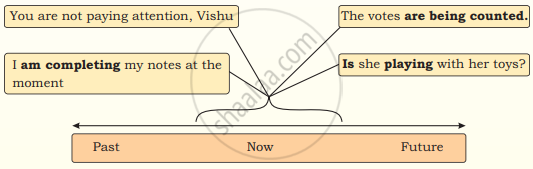
- S + is/am/are + verb + ing
- S + is/am/are + not + verb + ing.
- Is/am/are + S + verb + ing?
- S + is/am/are + being + Verb (past participle)
Advertisements
Solution
- am eating
- are getting, am coming
- are rising
- are, wearing
- am, doing
- is leaving
- are
- makes
- writing
| (a) Something pre-arranged or a fixed plan | is leaving |
| (b) Insistence | are, wearing |
| (c) Annoyance | are |
| (d) Repeated action | am eating |
| (e) Some development or change | are rising |
| (f) Emphatic refusal | am, doing |
| (g) Something happening ‘around now’ | writing |
| (h) An action just starting | are getting, am coming |
| (i) Temporary action not necessarily taking place at the moment of speaking | am eating |
APPEARS IN
RELATED QUESTIONS
Now compare your answers with those of your partner and discuss the
following questions and write your observations in the given space.
a. Is the time referred to in the sentences always the same as the tense of
the verb? What conclusion can you draw from your observation? Write
your observation below.
...............................................................................................................................................
..................................................................................................................................................
b. How have you found the tense of the verbs in the sentences above? Are
there any indicators or markers that reveal the tense of the verb? Write
your observation below.
...............................................................................................................................................
..................................................................................................................................................
c. Did you find any verb form that could be called 'future form'? (You will
learn more about the different ways of talking about future later in this
unit.)
...............................................................................................................................................
..................................................................................................................................................
d. Why do you think verb forms are often labelled as 'simple' or 'indefinite', 'progressive' or 'continuous', 'perfect' and 'perfect continuous'?
...............................................................................................................................................
..................................................................................................................................................
Present Perfect vs. Simple Past
a. Explain the difference in the meaning of the following pairs of
sentences. You may like to use the given hints.
1. a. I have been a teacher for five years.
b. I was a teacher for five years.
(Hint: Is the speaker still a teacher?)
2. a. I always got good marks in English.
b. I have always got good marks in English.
(Hint: Is the speaker still studying?)
3. a. Geeta has never met her cousin.
b. Geeta never met her cousin.
(Hint: Is Geeta's cousin alive?)
4. a. I have never been to Timbuktu.
b. I never went to Timbuktu.
(Is the speaker talking about a particular journey or his travels so far?)
5. a. Jose has completed seven assignments today.
b. Jose completed seven assignments today.
(Hint: Is the day over? Has Jose more assignments to write?)
Complete the following sentences with the appropriate forms of the given verbs.
1. Every day I(go) to school in a bus but today I (go) by car because the bus operators are on strike.
2. "Baichung Bhutia (pass) the ball to Bannerjee; Bannerjee (take) a shot at the goal but it (be) way above the goal post. The Indians (attack) much more now ... "
3. I (think) you (make) a mistake by signing this contract.
4. The doctor (say) mother (respond) to the treatment well.
5. Farzana (be) not well. She (not come) to school today.
Present Perfect vs. Simple Past
b. What conclusion can you draw from these sentences about the use of present perfect and simple past forms of verbs?
-----------------------------------
-----------------------------------
-----------------------------------
Complete the following sentences correctly by using the simple past or
past perfect forms of the given verbs.
1) We ____ already (reach) home when Irlan __ (say) that he (forget) his books at school.
2) Wendy (wake up) late, then she ____ (miss) her school bus, so by the time she (reach) school, it already (start).
3) I ___ (visit) my town again ten years after I _____ (leave) it and ___ (find) thatit completely (change).
4) When Feroze and Mehr (meet) for the first time, they ___ _ (not like) each other but now they are married.
Working with the same partner, use the information given below and
discuss the reasons for choosing a particular verb form in F .1. Then match
the information in the bubbles below with the sentences, and put the
sentence number in the space provided, as shown in the example.
| 1. e.g. Something is expected to happen before a particular time in the future. (Sentence No 2) |
2.Statement of a universal truth or fact. ( ) |
|
3.Something is expected to ( ) |
4.Simple statement of future ( ) |
|
5.Sure to happen at a particular time in the future, as arrangements for it ( ) |
6.Statement of a planned event expected. ( } |
Work with apartner
In the following sentences, choose and circle the verb form you think best fits the meaning of each sentence. You have been provided an example.
| 1. Tomorrow | is will be is going to be | Wednesday. |
| 2. The train | has left will have left is going to leave | by the time you reach the station. |
| 3. Hurry! The film | does will is about to | start. |
| 4. The Minister | opens is opening is about to open | the new Art Centrenext week. |
| 5. This time next year, he | will live is living will be living | in Mumbai. |
| 6. I | am going to be will be will have been | a nurse when I grow up |
The Dauphin will give me all I need.
(Rewrite the sentence using the present perfect tense)
Name the Tense of the Verb underlined to include Time (Past/Present/Future) and Aspect (Simple/Continuous/Perfect/Perfect Continuous).
I have been facing death.
Name the Tense of the Verb underlined to include Time (Past/Present/Future) and Aspect (Simple/Continuous/Perfect/Perfect Continuous).
I shall be telling you three stories.
Change the Tense as instructed.
I got fired. (Future Perfect)
Change the Tense as instructed.
The dots will somehow connect. (Past Perfect)
Observe the following underlined phrases. Here ‘have/has’ are followed by the past participle form of the verb. This construction indicates the present perfect tense. Find more such sentences from the text.
- We have made progress in the last couple of decades.
- We have prevented millions of child deaths.
- It has happened.
Present Participle: The form of a verb, ending in ‘ing’, which is used in forming continuous tenses. For example, He is sitting here.
Present participle can also be used as an adjective. For example, He uses a walking stick.
Now, find out the ‘ing’ forms from the story and classify them into the following table.
| Present Participle used as an Adjective | Present Participle used as a Verb in the Continuous Tense |
| twinkling eyes | was oozing |
| 1. | |
| 2. | |
| 3. | |
| 4. |
Underline the verb and choose the correct option from the options.
Preeti was scornful.
(singular/plural)
Read the following sentence carefully, underline the verb and find out the tense in the sentence.
She is standing on a little high hump on the plateau.
Read the following sentence carefully, underline the verb and find out the tense in the sentence.
He leaned out eagerly.
Rewrite the sentence in future tense:
I am doing it.
Rewrite the sentence in simple future tense.
He has been playing since afternoon.
