Advertisements
Advertisements
Question
The present perfect is often used with the following time expressions:
until now for many years
so far over the last few years
lately in the past few months
not yet since20xx
recently
in recent years
Choose five of these time expressions and make sentences about interesting
items of news concerning yourself.
------------------------------------------
------------------------------------------
Now make groups of four, and tell (not read) each other your news.
Advertisements
Solution
- Until now I have not known how I met with an accident.
- So far I have not known where the extra-terrestrial creatures come from.
- Mohan has not yet revealed what for he came to me.
- I have not met my friend recently.
- My brother has grown plump in recent years.
- For classroom discussion
APPEARS IN
RELATED QUESTIONS
Let us begin by studying the relationship between the different verb forms and the time they denote.
Work individually
Indicate the tense and time of each of the highlighted verbs in the table below.
The first has been done as an example.
| Sentence | Tense | Time | |
| 1. | We are planning to go out for a picnic tomorrow. | Present | Future |
| 2. | India has made tremendous progress in the past few decades. |
||
| 3. | It has been raining since morning. | ||
| 4. | Could you please send your e-mail address as soon as possible? |
||
| 5. | The train must have reached Delhi by now. |
||
| 6. | It always rains in July here. | ||
| 7. | Cold wave intensifies further. (A news headline) |
||
| 8. | He was playing here a minute ago. | ||
| 9. | She won the Student of the Year award last year. |
||
| 10. | All incomplete forms will be rejected. |
Now compare your answers with those of your partner and discuss the
following questions and write your observations in the given space.
a. Is the time referred to in the sentences always the same as the tense of
the verb? What conclusion can you draw from your observation? Write
your observation below.
...............................................................................................................................................
..................................................................................................................................................
b. How have you found the tense of the verbs in the sentences above? Are
there any indicators or markers that reveal the tense of the verb? Write
your observation below.
...............................................................................................................................................
..................................................................................................................................................
c. Did you find any verb form that could be called 'future form'? (You will
learn more about the different ways of talking about future later in this
unit.)
...............................................................................................................................................
..................................................................................................................................................
d. Why do you think verb forms are often labelled as 'simple' or 'indefinite', 'progressive' or 'continuous', 'perfect' and 'perfect continuous'?
...............................................................................................................................................
..................................................................................................................................................
Form
• Have/has+ past participle
• Have/ has+ been + past participle
Work individually
Complete the following sentences by using the present perfect form (as
given in C.l)ofthe given verbs.
a) The kids (work) really hard for the show. Now, don't cancel it, please.
b) Yippyl I (select) for the interschool dance competition!
c) I ... (contest) five elections so far.
d) John? 0, he is a delightful boy. I (know) him since his childhood.
e) ... you ever (be) to the Taj Mahal?
• The box below shows different uses or meanings of the present perfect. Match the sentences above with the uses or meanings of the present perfect they illustrate.
i) Something that has happened several times up to the present.
ii) Announcement or news of a recent event.
iii) Finished event connected with the present.
iv) An action or situation that has continued up to the present.
v} Finished event at some/ any time up to now.
Answer: i - c; ii - b; iii - a; iv - d; v - e
Study the following picture carefully and then write a paragraph to describe what is happening.
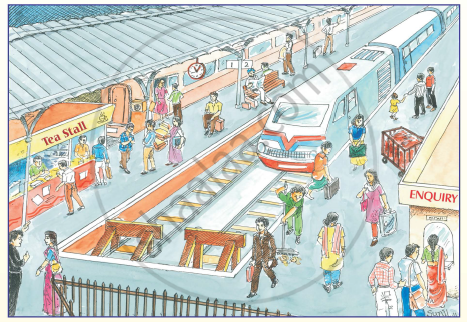
Here is a letter Nikita wrote to her friend Susie who lives in Milan, Italy. What verb forms has she used in this letter? Bas she used a mix of verb forms? Is there any particular form that has been used more frequently?
Dear Susie
It's a beautiful Sunday morning. Rakesh is busy with some office work and the kids are playing in the park outside and I've time enough to write a quick letter to you.
So, how are you doing? How's your new novel coming along? I hear you're learning Bharatnatyam these days. Couldn't believe it when Sharon told me about it. Bhartnatyam in Milani Never knew there is an Indian Dance school in Italy. Interesting! By the way, who are you taking dance lessons from? I mean, who is your Guru? And why are you learning Bharatnatyam? Must you do everything that I do?
What happened to your plan to visit us this winter? Well, winter is round the corner. When are you coming? How long do you plan to stay? What places would you like to visit? Do let me know, will you? I'll make your itinerruy accordingly. Remember, this time when you come, you are not staying at any hotel as you did last time. You will stay with us. I have a room spare for you to stay as long as you wish. OK? As for the weather, I've already told you, winter is setting in. It's beginning to get cold, especially in the mornings and the evenings. The temperature is falling with each passing day and it's just the right kind of weather for some travel and adventure. Delhi is at its best in the early winter and it is waiting to welcome you with open arms. And how's your mom's health now? Is she keeping well? Is she getting physiotherapy done regularly? I continue to pray for her speedy recovery. I think I got to go now. The kids seem to have had a fight. I can hear the youngerone crying. These boys are giving me a difficult time! Catchyoulater. Bye
Yours
Nikita
What has been the situation of your village/town/city five to ten years ago and how has it changed since then? Write a short paragraph describing the changes in its size, population, traftlc, buildings, lifestyle etc. Which verb forms would you mainly use to describe the changes? (Hint: Simple Past and Present Perfect forms.)
Read this sentence.
M. Hamel had said that he would question us on participles.
In the sentence above, the verb form “had said” in the first part is used to indicate an “earlier past.” The whole story is narrated in the past. M. Hamel’s “saying” happened earlier than the events in this story. This form of the verb is called the past perfect.
Pick out five sentences from the story with this form of verb and say why this form has been used.
Use the correct tense form of the verb given in the bracket and rewrite the sentence.
She ________ at her left shoulder for quite some time.
Name the Tense of the Verb underlined to include Time (Past/Present/Future) and Aspect (Simple/Continuous/Perfect/Perfect Continuous).
I have been facing death.
Observe the following underlined phrases. Here ‘have/has’ are followed by the past participle form of the verb. This construction indicates the present perfect tense. Find more such sentences from the text.
- We have made progress in the last couple of decades.
- We have prevented millions of child deaths.
- It has happened.
Rewrite the sentence as per the instruction given along with it.
She simply sat there quietly.
(Rewrite the sentence in the Present Continuous Tense)
Underline the verb and choose the correct option from the options.
Today Sanjay found a new book.
(present tense/past tense)
Underline the verb and choose the correct option from the options.
Preeti was scornful.
(singular/plural)
Read the following sentence carefully, underline the verb and find out the tense in the sentence.
She is standing on a little high hump on the plateau.
Read the following sentence carefully, underline the verb and find out the tense in the sentence.
He leaned out eagerly.
Match the sentences given in part ‘A’ with the sentences given in part ‘B’. Note the differences in structure.
| ‘A’ Part | ‘B’ Part |
| (1) He was kidnapped by an extremist militia. | (a) They forced the child to kill his friends and family. |
| (2) The child was forced to kill his friends and family. | (b) An extremist militia kidnapped him. |
Observe the following underlined phrases. Here ‘have/has’ are followed by the past participle form of the verb. This construction indicates the perfect present tense. Find more such sentences from the speech.
- We have made progress in the last couple of decades.
- We have prevented millions of child deaths.
- It has happened.
- ...................................
- ...................................
- ...................................
Rewrite the sentence in future tense:
I am doing it.
