Advertisements
Advertisements
प्रश्न
The present perfect is often used with the following time expressions:
until now for many years
so far over the last few years
lately in the past few months
not yet since20xx
recently
in recent years
Choose five of these time expressions and make sentences about interesting
items of news concerning yourself.
------------------------------------------
------------------------------------------
Now make groups of four, and tell (not read) each other your news.
Advertisements
उत्तर
- Until now I have not known how I met with an accident.
- So far I have not known where the extra-terrestrial creatures come from.
- Mohan has not yet revealed what for he came to me.
- I have not met my friend recently.
- My brother has grown plump in recent years.
- For classroom discussion
APPEARS IN
संबंधित प्रश्न
Study the following picture carefully and then write a paragraph to describe what is happening.
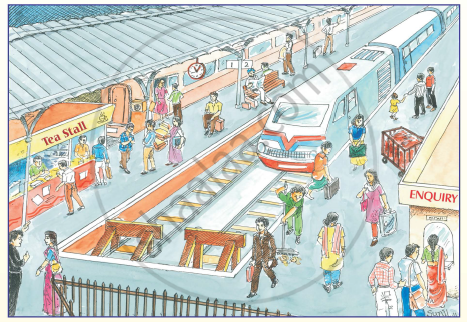
Look at the incomplete sentences below. Using the information provided, complete each sentence using a suitable tense. Follow the examples:
1947 until now India I has been (be) independent since 1947.
1947 India became (become) independent in 1947.
1. 1947 until now l There --------- (be) manywars.
2. 1991 There ------- (be) a war in the Persian Gulf.
3. 1953 -------- Edmund Hilary and Tensing first (climb) Everest.
4. 1953 until now Many people ________ (climb)Everest.
5. 1983 India --------- (win) the Prudential Cricket World Cup in England.
6. 1983 until now India -------- (win) many limited-overs cricket trophies.
Study the following sentences.
1) I didn't know Jim had migrated to the United States.
2) When we arrived at the theatre, the show had already begun.
3) The patient had died before the ambulance reached the hospital.
4) He had got married by the time he started working.
5) I couldn't open the locker because I had mislaid the keys.
6) Byom Bakshi felt that he had seen the man somewhere before.
As you can see, each of the above sentences describes two different actions, events or situations. Work with a partner and list them as shown in the example.
| A. Occurred First | B. Occurred Later |
| 1. Example: Jim had migrated to the United States. | 1. I did not know it. The speaker came to know the fact later.) |
| 2. | 2. |
| 3. | 3. |
| 4. | 4. |
| 5. | 5. |
| 6. | 6. |
What verb forms have been used in (A) and (B) respectively?
A. ....................................................................
B ....................................................................
What conclusion can you draw from your analysis?
...................................................................
...................................................................
Carefully study each of the following events or situations described in a set of three sentences/phrases. Then, write a short paragraph to describe each event/situation as shown in the example. Your paragraph should begin with the description of the second event in each case. Use the verb form had+ past participle to describe the earliest of the past events.
|
• Somebody burgled the office on Sunday night. • Our arrival at work on Monday morning . • Police informed |
We arrived at work on Monday and found that somebody had burgled the office the previous night. So, we immediately informed the police. |
|
• (I) Mayank went out with his family. (ii) I tried to phone him this morning. (iii) His servant answered. |
I tried to phone Mayank this morning but the servant ........................................... ........................................... |
|
• (i) Rohit returned from holiday.(ii) Jayanti met Rohit. |
Jayanti met Rohit, who ........................................... ........................................... |
|
• (I) All the arrangements were finalised for the seminar. (ii) The seminar participants arrived in Gangtok. (iii) Met the professors from the UK the same evening. |
The participants arrived in Gangtok. They found ........................................... ........................................... |
Tenses -Summary
Read the biodata of Sangeeta Rani Puri, India's swimming sensation. Then, complete the interview in the spaces provided. Do NOT add any extra information. Use appropriate tenses.
|
Natne : Sangeeta Rani Puri Status : Non-resident Indian Place of Birth : Trinidad Place of Residence : USA Parents : Raj Krishna Puri (Father) -fatnous immigration lawyer Moyna Margaret Puri (mother) - (from Trinidad) Achievements records : i) six new national records in five day (Junior National Swimming Meet, Vijaywada) |
Interviewer: Sangeeta, since you were in India for only a short while before
you flew to Atlanta, would you tell us a little about yourself?
Sangeeta : Well, I'm an Indian and I'm proud to be one.
I: Please tell us about your parents.
S: My father ____________________
_______________________ from Trinidad.
I: Have you taken part in any of the National Championships?
S: (Very excited) Yes,_________at Vijaywada.
I: How ______________________________________________ Senior Nationals?
S: I won seven events and __________
I: How do you rate your performance in the Altanta Olympics in 1996?
S: I ___________________________ in the 50 metres freestyle. It's true that I _____________in Atlanta. But _____________________
I: Haveyou ___________________ forthefuture?
S: I in the USA. And of course I ____________for as long as possible. Also I _______________________ in the olympics.
I: Thank you, Sangeeta. I wish you all the best.
S: Thankyouverymuch.
Working with the same partner, use the information given below and
discuss the reasons for choosing a particular verb form in F .1. Then match
the information in the bubbles below with the sentences, and put the
sentence number in the space provided, as shown in the example.
| 1. e.g. Something is expected to happen before a particular time in the future. (Sentence No 2) |
2.Statement of a universal truth or fact. ( ) |
|
3.Something is expected to ( ) |
4.Simple statement of future ( ) |
|
5.Sure to happen at a particular time in the future, as arrangements for it ( ) |
6.Statement of a planned event expected. ( } |
The Dauphin will give me all I need.
(Rewrite the sentence using the present perfect tense)
Use the correct tense form of the verb given in the bracket and rewrite the sentence.
She ________ that old fashion book of her mother a few months back.
Name the Tense of the Verb underlined to include Time (Past/Present/Future) and Aspect (Simple/Continuous/Perfect/Perfect Continuous).
We were designing the first Macintosh computer.
Change the Tense as instructed.
Life hits you in the head. (Present Perfect Continuous)
Change the Tense as instructed.
I started the company. (Present Continuous)
Change the Tense as instructed.
My doctor advised me. (Past Perfect Continuous)
Present Participle: The form of a verb, ending in ‘ing’, which is used in forming continuous tenses. For example, He is sitting here.
Present participle can also be used as an adjective. For example, He uses a walking stick.
Now, find out the ‘ing’ forms from the story and classify them into the following table.
| Present Participle used as an Adjective | Present Participle used as a Verb in the Continuous Tense |
| twinkling eyes | was oozing |
| 1. | |
| 2. | |
| 3. | |
| 4. |
Rewrite the sentence as per the instruction given along with it.
She simply sat there quietly.
(Rewrite the sentence in the Present Continuous Tense)
Underline the verb and choose the correct option from the options.
Preeti even wrote about it.
(present tense/past tense)
Underline the verb and choose the correct option from the options.
Today Sanjay found a new book.
(present tense/past tense)
Underline the verb and choose the correct option from the options.
They are sportsmen.
(singular/plural)
Read the following sentence carefully, underline the verb and find out the tense in the sentence.
He just felt dizzy.
