Advertisements
Advertisements
प्रश्न
Present Perfect vs. Simple Past
b. What conclusion can you draw from these sentences about the use of present perfect and simple past forms of verbs?
-----------------------------------
-----------------------------------
-----------------------------------
Advertisements
उत्तर
The conclusion I draw from these sentences is that many of these show completion of an action in the past. Some show that the action is still not complete and is to be completed next. Actually present perfect tense shows that the action is complete at the time of speaking. An action denoted by past means that the action went on for some time but is not shown to have been completed.
APPEARS IN
संबंधित प्रश्न
Change the following sentence into simple sentence.
Einstein smiled and put his arm across my shoulder.
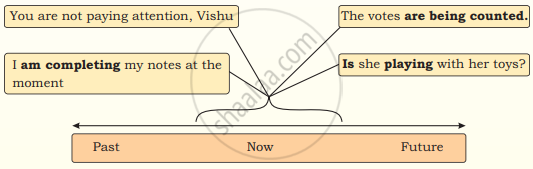
- S + is/am/are + verb + ing
- S + is/am/are + not + verb + ing.
- Is/am/are + S + verb + ing?
- S + is/am/are + being + Verb (past participle)
Complete the following sentences with the appropriate forms of the given verbs.
1. Every day I(go) to school in a bus but today I (go) by car because the bus operators are on strike.
2. "Baichung Bhutia (pass) the ball to Bannerjee; Bannerjee (take) a shot at the goal but it (be) way above the goal post. The Indians (attack) much more now ... "
3. I (think) you (make) a mistake by signing this contract.
4. The doctor (say) mother (respond) to the treatment well.
5. Farzana (be) not well. She (not come) to school today.
Look at the incomplete sentences below. Using the information provided, complete each sentence using a suitable tense. Follow the examples:
1947 until now India I has been (be) independent since 1947.
1947 India became (become) independent in 1947.
1. 1947 until now l There --------- (be) manywars.
2. 1991 There ------- (be) a war in the Persian Gulf.
3. 1953 -------- Edmund Hilary and Tensing first (climb) Everest.
4. 1953 until now Many people ________ (climb)Everest.
5. 1983 India --------- (win) the Prudential Cricket World Cup in England.
6. 1983 until now India -------- (win) many limited-overs cricket trophies.
Here is a letter Nikita wrote to her friend Susie who lives in Milan, Italy. What verb forms has she used in this letter? Bas she used a mix of verb forms? Is there any particular form that has been used more frequently?
Dear Susie
It's a beautiful Sunday morning. Rakesh is busy with some office work and the kids are playing in the park outside and I've time enough to write a quick letter to you.
So, how are you doing? How's your new novel coming along? I hear you're learning Bharatnatyam these days. Couldn't believe it when Sharon told me about it. Bhartnatyam in Milani Never knew there is an Indian Dance school in Italy. Interesting! By the way, who are you taking dance lessons from? I mean, who is your Guru? And why are you learning Bharatnatyam? Must you do everything that I do?
What happened to your plan to visit us this winter? Well, winter is round the corner. When are you coming? How long do you plan to stay? What places would you like to visit? Do let me know, will you? I'll make your itinerruy accordingly. Remember, this time when you come, you are not staying at any hotel as you did last time. You will stay with us. I have a room spare for you to stay as long as you wish. OK? As for the weather, I've already told you, winter is setting in. It's beginning to get cold, especially in the mornings and the evenings. The temperature is falling with each passing day and it's just the right kind of weather for some travel and adventure. Delhi is at its best in the early winter and it is waiting to welcome you with open arms. And how's your mom's health now? Is she keeping well? Is she getting physiotherapy done regularly? I continue to pray for her speedy recovery. I think I got to go now. The kids seem to have had a fight. I can hear the youngerone crying. These boys are giving me a difficult time! Catchyoulater. Bye
Yours
Nikita
As Susie, write a reply to Nikita's letter. Do take care to answer all the
questions Nikita has asked you. What verb forms would you like to use?
Milan
25th October, 2011
Dear Nikita
.............................................................................................................................................
.............................................................................................................................................
.............................................................................................................................................
Yours
Susie
Simple Past Tense-Past Perfect Tense
Underline the main verbs in the sentences below. Then, rewrite the sentences in the correct order of events.
1) The people began to starve.
2) In 1925, a disease destroyed the crops in one village.
3) Later, the village people came to retrieve their children
4) The chief decided to send the children of the village to live in a settlement in the next valley.
5) However, they had married outside the village.
6) This caused a war between the two villages.
__________________
__________________
Now work with your partner and tick (✓) the sentence in which a different tense has been used. In pairs, discuss why this has been done.
Sentence No: 5 uses a different tense because ..................................................................................................................................................
..................................................................................................................................................
The present perfect is often used with the following time expressions:
until now for many years
so far over the last few years
lately in the past few months
not yet since20xx
recently
in recent years
Choose five of these time expressions and make sentences about interesting
items of news concerning yourself.
------------------------------------------
------------------------------------------
Now make groups of four, and tell (not read) each other your news.
Complete the following sentences correctly by using the simple past or
past perfect forms of the given verbs.
1) We ____ already (reach) home when Irlan __ (say) that he (forget) his books at school.
2) Wendy (wake up) late, then she ____ (miss) her school bus, so by the time she (reach) school, it already (start).
3) I ___ (visit) my town again ten years after I _____ (leave) it and ___ (find) thatit completely (change).
4) When Feroze and Mehr (meet) for the first time, they ___ _ (not like) each other but now they are married.
Carefully study each of the following events or situations described in a set of three sentences/phrases. Then, write a short paragraph to describe each event/situation as shown in the example. Your paragraph should begin with the description of the second event in each case. Use the verb form had+ past participle to describe the earliest of the past events.
|
• Somebody burgled the office on Sunday night. • Our arrival at work on Monday morning . • Police informed |
We arrived at work on Monday and found that somebody had burgled the office the previous night. So, we immediately informed the police. |
|
• (I) Mayank went out with his family. (ii) I tried to phone him this morning. (iii) His servant answered. |
I tried to phone Mayank this morning but the servant ........................................... ........................................... |
|
• (i) Rohit returned from holiday.(ii) Jayanti met Rohit. |
Jayanti met Rohit, who ........................................... ........................................... |
|
• (I) All the arrangements were finalised for the seminar. (ii) The seminar participants arrived in Gangtok. (iii) Met the professors from the UK the same evening. |
The participants arrived in Gangtok. They found ........................................... ........................................... |
Name the Tense of the Verb underlined to include Time (Past/Present/Future) and Aspect (Simple/Continuous/Perfect/Perfect Continuous).
I shall be telling you three stories.
Change the Tense as instructed.
My doctor advised me. (Past Perfect Continuous)
Observe the following underlined phrases. Here ‘have/has’ are followed by the past participle form of the verb. This construction indicates the present perfect tense. Find more such sentences from the text.
- We have made progress in the last couple of decades.
- We have prevented millions of child deaths.
- It has happened.
Present Participle: The form of a verb, ending in ‘ing’, which is used in forming continuous tenses. For example, He is sitting here.
Present participle can also be used as an adjective. For example, He uses a walking stick.
Now, find out the ‘ing’ forms from the story and classify them into the following table.
| Present Participle used as an Adjective | Present Participle used as a Verb in the Continuous Tense |
| twinkling eyes | was oozing |
| 1. | |
| 2. | |
| 3. | |
| 4. |
Spot the error and correct the following sentence.
My grandparents laid down for an afternoon nap.
Rewrite the sentence as per the instruction given along with it.
She simply sat there quietly.
(Rewrite the sentence in the Present Continuous Tense)
Underline the verb and choose the correct option from the options.
Today Sanjay found a new book.
(present tense/past tense)
Read the following sentence carefully, underline the verb and find out the tense in the sentence.
She is standing on a little high hump on the plateau.
Rewrite the sentence in the simple present tense.
He will go to the school.
