Advertisements
Advertisements
प्रश्न
As Susie, write a reply to Nikita's letter. Do take care to answer all the
questions Nikita has asked you. What verb forms would you like to use?
Milan
25th October, 2011
Dear Nikita
.............................................................................................................................................
.............................................................................................................................................
.............................................................................................................................................
Yours
Susie
Advertisements
उत्तर
Milan
25th October, 20 – –
Dear Nikita
It was a great pleasure to go through your loving letter. I find it interesting that you have to do a lot of work at your end. Here I am also leading a very busy schedule of time. I am trying to reply to all your queries.
I am doing fine. I haven’t been able to spare more time to the writing of the novel. Regarding Bharatnatyam I am learning it and find it is simply awesome. Here in Milan the Indian Dance School is providing this facility to a lot of Indian and Italian students. Mr. Subramaniam Swamy imparts training and teaches various norms. I am learning Bharatnatyam as I have a passion to learn it.
I am still contemplating to visit you this winter. The winter is welcome at your end. However, it is not that much intense as it is here in Milan. I think we should come next month. We plan to stay for a short period after we come. We would like to visit New Delhi, Jaipur, Agra, Udaipur, Gwalior etc. It shall be a great pleasure to stay with you. I shall surely write to you about our visiting dates,as and when these are finalised.
My mom is getting better. She is receiving physiotherapy regularly and is improving day by day.
I shall write again as I have to go to attend my Bharatnatyam class.
Yours
Susie
APPEARS IN
संबंधित प्रश्न
Let us begin by studying the relationship between the different verb forms and the time they denote.
Work individually
Indicate the tense and time of each of the highlighted verbs in the table below.
The first has been done as an example.
| Sentence | Tense | Time | |
| 1. | We are planning to go out for a picnic tomorrow. | Present | Future |
| 2. | India has made tremendous progress in the past few decades. |
||
| 3. | It has been raining since morning. | ||
| 4. | Could you please send your e-mail address as soon as possible? |
||
| 5. | The train must have reached Delhi by now. |
||
| 6. | It always rains in July here. | ||
| 7. | Cold wave intensifies further. (A news headline) |
||
| 8. | He was playing here a minute ago. | ||
| 9. | She won the Student of the Year award last year. |
||
| 10. | All incomplete forms will be rejected. |
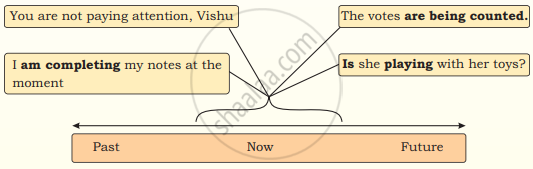
- S + is/am/are + verb + ing
- S + is/am/are + not + verb + ing.
- Is/am/are + S + verb + ing?
- S + is/am/are + being + Verb (past participle)
Verbs that are normally NOT used in the progressive form.
1. Which sentence in each of the following pairs is acceptable and
why?
1. a. I am respecting you.
b. I respect you.
2. a. My son loves to draw and paint.
b. My son is loving to draw and paint.
3. a. We are having two cars.
b. We have two cars.
4. a. I am thinking you are new to this place.
b. I think you are new to this place.
5. a. The cake smells good.
b. The cake is smelling good.
| Verbs referring to mental states (eg. know, think, believe etc) and to the use of the senses (eg. smell, taste etc) are never, or hardly ever, used in progressive forms. Some of these verbs are: believe prefer know suppose feel sound (dis)like love realise understand hear taste see hate recognise want see belong doubt imagme remember wish smell agree possess own owe involve include depend |
Can you explain the difference between?
1. a. l justcan'timaginehowyougotintosuchamess.
b. You're imagining things nothing will happen.
2. a. The coffee tastes bitter
b. Mother is tasting coffee to check ifit is too bitter.
3. a. My teacher admires my art work
b. She is admiring the latest painting I have made.
4. a. The doctor is feeling the patient's pulse.
b. The patient is feeling better.
Look at the incomplete sentences below. Using the information provided, complete each sentence using a suitable tense. Follow the examples:
1947 until now India I has been (be) independent since 1947.
1947 India became (become) independent in 1947.
1. 1947 until now l There --------- (be) manywars.
2. 1991 There ------- (be) a war in the Persian Gulf.
3. 1953 -------- Edmund Hilary and Tensing first (climb) Everest.
4. 1953 until now Many people ________ (climb)Everest.
5. 1983 India --------- (win) the Prudential Cricket World Cup in England.
6. 1983 until now India -------- (win) many limited-overs cricket trophies.
Here is a letter Nikita wrote to her friend Susie who lives in Milan, Italy. What verb forms has she used in this letter? Bas she used a mix of verb forms? Is there any particular form that has been used more frequently?
Dear Susie
It's a beautiful Sunday morning. Rakesh is busy with some office work and the kids are playing in the park outside and I've time enough to write a quick letter to you.
So, how are you doing? How's your new novel coming along? I hear you're learning Bharatnatyam these days. Couldn't believe it when Sharon told me about it. Bhartnatyam in Milani Never knew there is an Indian Dance school in Italy. Interesting! By the way, who are you taking dance lessons from? I mean, who is your Guru? And why are you learning Bharatnatyam? Must you do everything that I do?
What happened to your plan to visit us this winter? Well, winter is round the corner. When are you coming? How long do you plan to stay? What places would you like to visit? Do let me know, will you? I'll make your itinerruy accordingly. Remember, this time when you come, you are not staying at any hotel as you did last time. You will stay with us. I have a room spare for you to stay as long as you wish. OK? As for the weather, I've already told you, winter is setting in. It's beginning to get cold, especially in the mornings and the evenings. The temperature is falling with each passing day and it's just the right kind of weather for some travel and adventure. Delhi is at its best in the early winter and it is waiting to welcome you with open arms. And how's your mom's health now? Is she keeping well? Is she getting physiotherapy done regularly? I continue to pray for her speedy recovery. I think I got to go now. The kids seem to have had a fight. I can hear the youngerone crying. These boys are giving me a difficult time! Catchyoulater. Bye
Yours
Nikita
The present perfect is often used with the following time expressions:
until now for many years
so far over the last few years
lately in the past few months
not yet since20xx
recently
in recent years
Choose five of these time expressions and make sentences about interesting
items of news concerning yourself.
------------------------------------------
------------------------------------------
Now make groups of four, and tell (not read) each other your news.
Find the incorrect sentences and then rewrite them correctly. Put a tick mark (✓)against the sentences that you think are correct.
1) By 2005, the singer recorded ten albums.
2) When I got to the bank, it had closed.
3) Timothy, the tiger, had killed five calves yesterday.
4) When Rehman met Mini ten years later, she grew up into a young girl.
5) By the time we reached the airport, the flight had left.
6) We hardly went a kilometre or so when the car broke down.
Working with the same partner, use the information given below and
discuss the reasons for choosing a particular verb form in F .1. Then match
the information in the bubbles below with the sentences, and put the
sentence number in the space provided, as shown in the example.
| 1. e.g. Something is expected to happen before a particular time in the future. (Sentence No 2) |
2.Statement of a universal truth or fact. ( ) |
|
3.Something is expected to ( ) |
4.Simple statement of future ( ) |
|
5.Sure to happen at a particular time in the future, as arrangements for it ( ) |
6.Statement of a planned event expected. ( } |
Work with apartner
In the following sentences, choose and circle the verb form you think best fits the meaning of each sentence. You have been provided an example.
| 1. Tomorrow | is will be is going to be | Wednesday. |
| 2. The train | has left will have left is going to leave | by the time you reach the station. |
| 3. Hurry! The film | does will is about to | start. |
| 4. The Minister | opens is opening is about to open | the new Art Centrenext week. |
| 5. This time next year, he | will live is living will be living | in Mumbai. |
| 6. I | am going to be will be will have been | a nurse when I grow up |
Use the correct tense form of the verb given in the bracket and rewrite the sentence.
She ________ that old fashion book of her mother a few months back.
Name the Tense of the Verb underlined to include Time (Past/Present/Future) and Aspect (Simple/Continuous/Perfect/Perfect Continuous).
We were designing the first Macintosh computer.
Spot the error and correct the following sentence.
My grandparents laid down for an afternoon nap.
Underline the verb and choose the correct option from the options.
Preeti was scornful.
(singular/plural)
Read the following sentence carefully, underline the verb and find out the tense in the sentence.
She is standing on a little high hump on the plateau.
Read the following sentence carefully, underline the verb and find out the tense in the sentence.
He just felt dizzy.
Match the sentences given in part ‘A’ with the sentences given in part ‘B’. Note the differences in structure.
| ‘A’ Part | ‘B’ Part |
| (1) He was kidnapped by an extremist militia. | (a) They forced the child to kill his friends and family. |
| (2) The child was forced to kill his friends and family. | (b) An extremist militia kidnapped him. |
Observe the following underlined phrases. Here ‘have/has’ are followed by the past participle form of the verb. This construction indicates the perfect present tense. Find more such sentences from the speech.
- We have made progress in the last couple of decades.
- We have prevented millions of child deaths.
- It has happened.
- ...................................
- ...................................
- ...................................
Fill in each of the numbered blanks with the correct form of the word given in brackets. Do not copy the passage but write in correct serial order the word or phrase appropriate to the blank space.
It was hot in the railway compartment and the fan ______ (1) (not work). The elderly lady ______ (2) (use) up all her water because she had cheerfully shared it with her fellow passengers. She knew that the train ______ (3) (halt) at the station for only three minutes. Calling a shoeshine boy she said, ‘Will you help me? I ______ (4) (need) a bottle of cold water and here is the money,' and she put a twenty rupee note in his hand. The boy snatched the money and ______ (5) (disappear) into the crowd on the platform. A fellow passenger ______ (6) (cannot believe) what he had witnessed. ‘What ______ (7) (you do)?’ He said, ‘You ______ (8) (never see) your money again.' Just then the whistle was heard and the train began to move. At that moment the child appeared at the window with the water. 'Your water,' he gasped, out of breath. ‘And the change.'
