Advertisements
Advertisements
प्रश्न
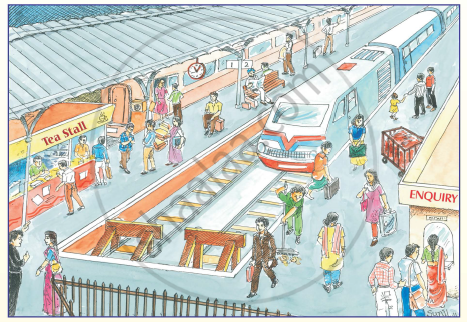
Study the following picture carefully and then write a paragraph to describe what is happening.
Advertisements
उत्तर
I find it interesting to describe the picture given above. It is the scene of the railway platform. The train has arrived some moments before at the platform. Some passengers are loading their luggage or belongings. Coolies are seen carrying goods to and fro on the platform. There are stalls selling various things needed by the passengers. Many passengers are walking to and fro to find the platform they are to go to. Some passengers are sipping tea while others are reading newspapers. Some are before the ‘Enquiry’ seeking information about the train they are to travel in. I hear the noise and hustle and bustle of a typical railway station platform. Some rehriwalas are serving purees and vegetables. The train which is about to leave the station seems to be starting to go. On the other platform passengers are waiting for their train to come. The railway platform is giving out a typical presentation of real India.
APPEARS IN
संबंधित प्रश्न
Form
• Have/has+ past participle
• Have/ has+ been + past participle
Work individually
Complete the following sentences by using the present perfect form (as
given in C.l)ofthe given verbs.
a) The kids (work) really hard for the show. Now, don't cancel it, please.
b) Yippyl I (select) for the interschool dance competition!
c) I ... (contest) five elections so far.
d) John? 0, he is a delightful boy. I (know) him since his childhood.
e) ... you ever (be) to the Taj Mahal?
• The box below shows different uses or meanings of the present perfect. Match the sentences above with the uses or meanings of the present perfect they illustrate.
i) Something that has happened several times up to the present.
ii) Announcement or news of a recent event.
iii) Finished event connected with the present.
iv) An action or situation that has continued up to the present.
v} Finished event at some/ any time up to now.
Answer: i - c; ii - b; iii - a; iv - d; v - e
Complete the following sentences with the appropriate forms of the given verbs.
1. Every day I(go) to school in a bus but today I (go) by car because the bus operators are on strike.
2. "Baichung Bhutia (pass) the ball to Bannerjee; Bannerjee (take) a shot at the goal but it (be) way above the goal post. The Indians (attack) much more now ... "
3. I (think) you (make) a mistake by signing this contract.
4. The doctor (say) mother (respond) to the treatment well.
5. Farzana (be) not well. She (not come) to school today.
As Susie, write a reply to Nikita's letter. Do take care to answer all the
questions Nikita has asked you. What verb forms would you like to use?
Milan
25th October, 2011
Dear Nikita
.............................................................................................................................................
.............................................................................................................................................
.............................................................................................................................................
Yours
Susie
Complete the following sentences correctly by using the simple past or
past perfect forms of the given verbs.
1) We ____ already (reach) home when Irlan __ (say) that he (forget) his books at school.
2) Wendy (wake up) late, then she ____ (miss) her school bus, so by the time she (reach) school, it already (start).
3) I ___ (visit) my town again ten years after I _____ (leave) it and ___ (find) thatit completely (change).
4) When Feroze and Mehr (meet) for the first time, they ___ _ (not like) each other but now they are married.
Find the incorrect sentences and then rewrite them correctly. Put a tick mark (✓)against the sentences that you think are correct.
1) By 2005, the singer recorded ten albums.
2) When I got to the bank, it had closed.
3) Timothy, the tiger, had killed five calves yesterday.
4) When Rehman met Mini ten years later, she grew up into a young girl.
5) By the time we reached the airport, the flight had left.
6) We hardly went a kilometre or so when the car broke down.
Working with the same partner, use the information given below and
discuss the reasons for choosing a particular verb form in F .1. Then match
the information in the bubbles below with the sentences, and put the
sentence number in the space provided, as shown in the example.
| 1. e.g. Something is expected to happen before a particular time in the future. (Sentence No 2) |
2.Statement of a universal truth or fact. ( ) |
|
3.Something is expected to ( ) |
4.Simple statement of future ( ) |
|
5.Sure to happen at a particular time in the future, as arrangements for it ( ) |
6.Statement of a planned event expected. ( } |
Use the correct tense form of the verb given in the bracket and rewrite the sentence.
All this ________ destroyed in a few years.
Name the Tense of the Verb underlined to include Time (Past/Present/Future) and Aspect (Simple/Continuous/Perfect/Perfect Continuous).
We were designing the first Macintosh computer.
Name the Tense of the Verb underlined to include Time (Past/Present/Future) and Aspect (Simple/Continuous/Perfect/Perfect Continuous).
I have been facing death.
Name the Tense of the Verb underlined to include Time (Past/Present/Future) and Aspect (Simple/Continuous/Perfect/Perfect Continuous).
I shall be telling you three stories.
Change the Tense as instructed.
Life hits you in the head. (Present Perfect Continuous)
Change the Tense as instructed.
My doctor advised me. (Past Perfect Continuous)
Present Participle: The form of a verb, ending in ‘ing’, which is used in forming continuous tenses. For example, He is sitting here.
Present participle can also be used as an adjective. For example, He uses a walking stick.
Now, find out the ‘ing’ forms from the story and classify them into the following table.
| Present Participle used as an Adjective | Present Participle used as a Verb in the Continuous Tense |
| twinkling eyes | was oozing |
| 1. | |
| 2. | |
| 3. | |
| 4. |
Rewrite the sentence as per the instruction given along with it.
I took the baby langur to our backyard.
(Rewrite the sentence in the Past Perfect Tense)
Underline the verb and choose the correct option from the options.
Preeti was scornful.
(singular/plural)
Read the following sentence carefully, underline the verb and find out the tense in the sentence.
She is standing on a little high hump on the plateau.
Match the sentences given in part ‘A’ with the sentences given in part ‘B’. Note the differences in structure.
| ‘A’ Part | ‘B’ Part |
| (1) He was kidnapped by an extremist militia. | (a) They forced the child to kill his friends and family. |
| (2) The child was forced to kill his friends and family. | (b) An extremist militia kidnapped him. |
Observe the following underlined phrases. Here ‘have/has’ are followed by the past participle form of the verb. This construction indicates the perfect present tense. Find more such sentences from the speech.
- We have made progress in the last couple of decades.
- We have prevented millions of child deaths.
- It has happened.
- ...................................
- ...................................
- ...................................
Rewrite the sentence in simple future tense.
He has been playing since afternoon.
