Advertisements
Advertisements
प्रश्न
Complete the following sentences correctly by using the simple past or
past perfect forms of the given verbs.
1) We ____ already (reach) home when Irlan __ (say) that he (forget) his books at school.
2) Wendy (wake up) late, then she ____ (miss) her school bus, so by the time she (reach) school, it already (start).
3) I ___ (visit) my town again ten years after I _____ (leave) it and ___ (find) thatit completely (change).
4) When Feroze and Mehr (meet) for the first time, they ___ _ (not like) each other but now they are married.
Advertisements
उत्तर
- had, reached, said, had forgotten
- woke up, missed, reached, had, started
- visited, had left, found, had, changed
- met, had not liked
APPEARS IN
संबंधित प्रश्न
Now compare your answers with those of your partner and discuss the
following questions and write your observations in the given space.
a. Is the time referred to in the sentences always the same as the tense of
the verb? What conclusion can you draw from your observation? Write
your observation below.
...............................................................................................................................................
..................................................................................................................................................
b. How have you found the tense of the verbs in the sentences above? Are
there any indicators or markers that reveal the tense of the verb? Write
your observation below.
...............................................................................................................................................
..................................................................................................................................................
c. Did you find any verb form that could be called 'future form'? (You will
learn more about the different ways of talking about future later in this
unit.)
...............................................................................................................................................
..................................................................................................................................................
d. Why do you think verb forms are often labelled as 'simple' or 'indefinite', 'progressive' or 'continuous', 'perfect' and 'perfect continuous'?
...............................................................................................................................................
..................................................................................................................................................
Present Perfect vs. Simple Past
b. What conclusion can you draw from these sentences about the use of present perfect and simple past forms of verbs?
-----------------------------------
-----------------------------------
-----------------------------------
Study the following picture carefully and then write a paragraph to describe what is happening.
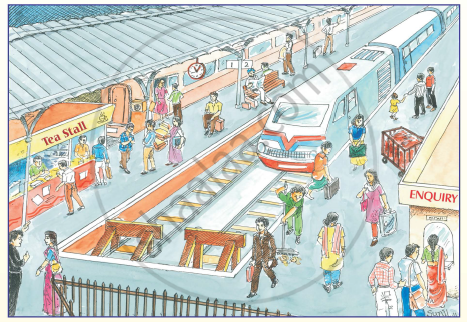
As Susie, write a reply to Nikita's letter. Do take care to answer all the
questions Nikita has asked you. What verb forms would you like to use?
Milan
25th October, 2011
Dear Nikita
.............................................................................................................................................
.............................................................................................................................................
.............................................................................................................................................
Yours
Susie
Simple Past Tense-Past Perfect Tense
Underline the main verbs in the sentences below. Then, rewrite the sentences in the correct order of events.
1) The people began to starve.
2) In 1925, a disease destroyed the crops in one village.
3) Later, the village people came to retrieve their children
4) The chief decided to send the children of the village to live in a settlement in the next valley.
5) However, they had married outside the village.
6) This caused a war between the two villages.
__________________
__________________
Now work with your partner and tick (✓) the sentence in which a different tense has been used. In pairs, discuss why this has been done.
Sentence No: 5 uses a different tense because ..................................................................................................................................................
..................................................................................................................................................
The present perfect is often used with the following time expressions:
until now for many years
so far over the last few years
lately in the past few months
not yet since20xx
recently
in recent years
Choose five of these time expressions and make sentences about interesting
items of news concerning yourself.
------------------------------------------
------------------------------------------
Now make groups of four, and tell (not read) each other your news.
Find the incorrect sentences and then rewrite them correctly. Put a tick mark (✓)against the sentences that you think are correct.
1) By 2005, the singer recorded ten albums.
2) When I got to the bank, it had closed.
3) Timothy, the tiger, had killed five calves yesterday.
4) When Rehman met Mini ten years later, she grew up into a young girl.
5) By the time we reached the airport, the flight had left.
6) We hardly went a kilometre or so when the car broke down.
Now write short paragraphs to describe the trends in the other groups of visitors featured in the graph.
• Overseas Visitors
....................................................
....................................................
• Domestic Visitors
....................................................
....................................................
• Total Number ofVisitors
....................................................
....................................................
Work with apartner
In the following sentences, choose and circle the verb form you think best fits the meaning of each sentence. You have been provided an example.
| 1. Tomorrow | is will be is going to be | Wednesday. |
| 2. The train | has left will have left is going to leave | by the time you reach the station. |
| 3. Hurry! The film | does will is about to | start. |
| 4. The Minister | opens is opening is about to open | the new Art Centrenext week. |
| 5. This time next year, he | will live is living will be living | in Mumbai. |
| 6. I | am going to be will be will have been | a nurse when I grow up |
Use the correct tense form of the verb given in the bracket and rewrite the sentence.
She ________ that old fashion book of her mother a few months back.
Use the correct tense form of the verb given in the bracket and rewrite the sentence.
All this ________ destroyed in a few years.
Name the Tense of the Verb underlined to include Time (Past/Present/Future) and Aspect (Simple/Continuous/Perfect/Perfect Continuous).
I am fine, now.
Name the Tense of the Verb underlined to include Time (Past/Present/Future) and Aspect (Simple/Continuous/Perfect/Perfect Continuous).
I have been facing death.
Name the Tense of the Verb underlined to include Time (Past/Present/Future) and Aspect (Simple/Continuous/Perfect/Perfect Continuous).
I shall be telling you three stories.
Rewrite the sentence as per the instruction given along with it.
The mother langur looked straight into my eyes.
(Rewrite the sentence in the Simple Present Tense)
Identify the type of sentence:
What a big challenge it is!
Rewrite the sentences in present perfect tense:
I had been working for Anil for almost a month.
Fill in each of the numbered blanks with the correct form of the word given in brackets. Do not copy the passage but write in correct serial order the word or phrase appropriate to the blank space.
It was hot in the railway compartment and the fan ______ (1) (not work). The elderly lady ______ (2) (use) up all her water because she had cheerfully shared it with her fellow passengers. She knew that the train ______ (3) (halt) at the station for only three minutes. Calling a shoeshine boy she said, ‘Will you help me? I ______ (4) (need) a bottle of cold water and here is the money,' and she put a twenty rupee note in his hand. The boy snatched the money and ______ (5) (disappear) into the crowd on the platform. A fellow passenger ______ (6) (cannot believe) what he had witnessed. ‘What ______ (7) (you do)?’ He said, ‘You ______ (8) (never see) your money again.' Just then the whistle was heard and the train began to move. At that moment the child appeared at the window with the water. 'Your water,' he gasped, out of breath. ‘And the change.'
