Advertisements
Advertisements
प्रश्न
Here is a letter Nikita wrote to her friend Susie who lives in Milan, Italy. What verb forms has she used in this letter? Bas she used a mix of verb forms? Is there any particular form that has been used more frequently?
Dear Susie
It's a beautiful Sunday morning. Rakesh is busy with some office work and the kids are playing in the park outside and I've time enough to write a quick letter to you.
So, how are you doing? How's your new novel coming along? I hear you're learning Bharatnatyam these days. Couldn't believe it when Sharon told me about it. Bhartnatyam in Milani Never knew there is an Indian Dance school in Italy. Interesting! By the way, who are you taking dance lessons from? I mean, who is your Guru? And why are you learning Bharatnatyam? Must you do everything that I do?
What happened to your plan to visit us this winter? Well, winter is round the corner. When are you coming? How long do you plan to stay? What places would you like to visit? Do let me know, will you? I'll make your itinerruy accordingly. Remember, this time when you come, you are not staying at any hotel as you did last time. You will stay with us. I have a room spare for you to stay as long as you wish. OK? As for the weather, I've already told you, winter is setting in. It's beginning to get cold, especially in the mornings and the evenings. The temperature is falling with each passing day and it's just the right kind of weather for some travel and adventure. Delhi is at its best in the early winter and it is waiting to welcome you with open arms. And how's your mom's health now? Is she keeping well? Is she getting physiotherapy done regularly? I continue to pray for her speedy recovery. I think I got to go now. The kids seem to have had a fight. I can hear the youngerone crying. These boys are giving me a difficult time! Catchyoulater. Bye
Yours
Nikita
Advertisements
उत्तर
In this letter the verb forms mostly used are of Present Indefinite and Present Continuous Tenses. Actually, these forms are a mix of various Tenses. Along with these Tenses, Present Perfect Tense has also been used. Students themselves shall see that usage of various Tenses depends greatly on the subject. This can be seen after reading the text of the letter.
APPEARS IN
संबंधित प्रश्न
Change the following sentence into simple sentence.
Einstein smiled and put his arm across my shoulder.
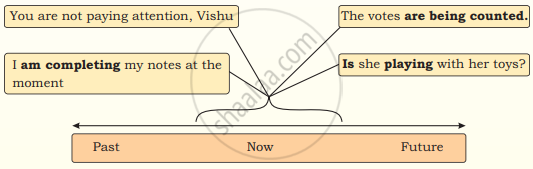
- S + is/am/are + verb + ing
- S + is/am/are + not + verb + ing.
- Is/am/are + S + verb + ing?
- S + is/am/are + being + Verb (past participle)
Present Perfect vs. Simple Past
a. Explain the difference in the meaning of the following pairs of
sentences. You may like to use the given hints.
1. a. I have been a teacher for five years.
b. I was a teacher for five years.
(Hint: Is the speaker still a teacher?)
2. a. I always got good marks in English.
b. I have always got good marks in English.
(Hint: Is the speaker still studying?)
3. a. Geeta has never met her cousin.
b. Geeta never met her cousin.
(Hint: Is Geeta's cousin alive?)
4. a. I have never been to Timbuktu.
b. I never went to Timbuktu.
(Is the speaker talking about a particular journey or his travels so far?)
5. a. Jose has completed seven assignments today.
b. Jose completed seven assignments today.
(Hint: Is the day over? Has Jose more assignments to write?)
What has been the situation of your village/town/city five to ten years ago and how has it changed since then? Write a short paragraph describing the changes in its size, population, traftlc, buildings, lifestyle etc. Which verb forms would you mainly use to describe the changes? (Hint: Simple Past and Present Perfect forms.)
Complete the following sentences correctly by using the simple past or
past perfect forms of the given verbs.
1) We ____ already (reach) home when Irlan __ (say) that he (forget) his books at school.
2) Wendy (wake up) late, then she ____ (miss) her school bus, so by the time she (reach) school, it already (start).
3) I ___ (visit) my town again ten years after I _____ (leave) it and ___ (find) thatit completely (change).
4) When Feroze and Mehr (meet) for the first time, they ___ _ (not like) each other but now they are married.
Carefully study each of the following events or situations described in a set of three sentences/phrases. Then, write a short paragraph to describe each event/situation as shown in the example. Your paragraph should begin with the description of the second event in each case. Use the verb form had+ past participle to describe the earliest of the past events.
|
• Somebody burgled the office on Sunday night. • Our arrival at work on Monday morning . • Police informed |
We arrived at work on Monday and found that somebody had burgled the office the previous night. So, we immediately informed the police. |
|
• (I) Mayank went out with his family. (ii) I tried to phone him this morning. (iii) His servant answered. |
I tried to phone Mayank this morning but the servant ........................................... ........................................... |
|
• (i) Rohit returned from holiday.(ii) Jayanti met Rohit. |
Jayanti met Rohit, who ........................................... ........................................... |
|
• (I) All the arrangements were finalised for the seminar. (ii) The seminar participants arrived in Gangtok. (iii) Met the professors from the UK the same evening. |
The participants arrived in Gangtok. They found ........................................... ........................................... |
Working with the same partner, use the information given below and
discuss the reasons for choosing a particular verb form in F .1. Then match
the information in the bubbles below with the sentences, and put the
sentence number in the space provided, as shown in the example.
| 1. e.g. Something is expected to happen before a particular time in the future. (Sentence No 2) |
2.Statement of a universal truth or fact. ( ) |
|
3.Something is expected to ( ) |
4.Simple statement of future ( ) |
|
5.Sure to happen at a particular time in the future, as arrangements for it ( ) |
6.Statement of a planned event expected. ( } |
Use the correct tense form of the verb given in the bracket and rewrite the sentence.
All this ________ destroyed in a few years.
Name the Tense of the Verb underlined to include Time (Past/Present/Future) and Aspect (Simple/Continuous/Perfect/Perfect Continuous).
I am fine, now.
Name the Tense of the Verb underlined to include Time (Past/Present/Future) and Aspect (Simple/Continuous/Perfect/Perfect Continuous).
I shall be telling you three stories.
Change the Tense as instructed.
I got fired. (Future Perfect)
Read the following sentence carefully, underline the verb and find out the tense in the sentence.
He just felt dizzy.
Match the sentences given in part ‘A’ with the sentences given in part ‘B’. Note the differences in structure.
| ‘A’ Part | ‘B’ Part |
| (1) He was kidnapped by an extremist militia. | (a) They forced the child to kill his friends and family. |
| (2) The child was forced to kill his friends and family. | (b) An extremist militia kidnapped him. |
Observe the following underlined phrases. Here ‘have/has’ are followed by the past participle form of the verb. This construction indicates the perfect present tense. Find more such sentences from the speech.
- We have made progress in the last couple of decades.
- We have prevented millions of child deaths.
- It has happened.
- ...................................
- ...................................
- ...................................
Identify the type of sentence:
What a big challenge it is!
Rewrite the sentence in future tense:
I am doing it.
Rewrite the sentence in the simple present tense.
He will go to the school.
