Advertisements
Advertisements
प्रश्न
Working with the same partner, use the information given below and
discuss the reasons for choosing a particular verb form in F .1. Then match
the information in the bubbles below with the sentences, and put the
sentence number in the space provided, as shown in the example.
| 1. e.g. Something is expected to happen before a particular time in the future. (Sentence No 2) |
2.Statement of a universal truth or fact. ( ) |
|
3.Something is expected to ( ) |
4.Simple statement of future ( ) |
|
5.Sure to happen at a particular time in the future, as arrangements for it ( ) |
6.Statement of a planned event expected. ( } |
Advertisements
उत्तर
In sentence 1, in F. 1 is, ie, the present tense, was chosen because near future is usually shown in this tense.
In sentence 2, in F.l the verb will have left was chosen because the sense of the sentence is in Future Perfect Tense.
In sentence 3, the verb is about to has been chosen because the sentence shows the indication of this action.
In sentence 4, the verb is opening was chosen because the action indicated by the sentence is sure to happen at a particular time in the future. This is shown by next week.
In sentence 5, the verb will be living was chosen because the action is a simple statement of future plan or intention.
In sentence 6, the verb am going to be was chosen because the sentence is a statement of a planned event expected to occur.
APPEARS IN
संबंधित प्रश्न
Let us begin by studying the relationship between the different verb forms and the time they denote.
Work individually
Indicate the tense and time of each of the highlighted verbs in the table below.
The first has been done as an example.
| Sentence | Tense | Time | |
| 1. | We are planning to go out for a picnic tomorrow. | Present | Future |
| 2. | India has made tremendous progress in the past few decades. |
||
| 3. | It has been raining since morning. | ||
| 4. | Could you please send your e-mail address as soon as possible? |
||
| 5. | The train must have reached Delhi by now. |
||
| 6. | It always rains in July here. | ||
| 7. | Cold wave intensifies further. (A news headline) |
||
| 8. | He was playing here a minute ago. | ||
| 9. | She won the Student of the Year award last year. |
||
| 10. | All incomplete forms will be rejected. |
Present Perfect vs. Simple Past
a. Explain the difference in the meaning of the following pairs of
sentences. You may like to use the given hints.
1. a. I have been a teacher for five years.
b. I was a teacher for five years.
(Hint: Is the speaker still a teacher?)
2. a. I always got good marks in English.
b. I have always got good marks in English.
(Hint: Is the speaker still studying?)
3. a. Geeta has never met her cousin.
b. Geeta never met her cousin.
(Hint: Is Geeta's cousin alive?)
4. a. I have never been to Timbuktu.
b. I never went to Timbuktu.
(Is the speaker talking about a particular journey or his travels so far?)
5. a. Jose has completed seven assignments today.
b. Jose completed seven assignments today.
(Hint: Is the day over? Has Jose more assignments to write?)
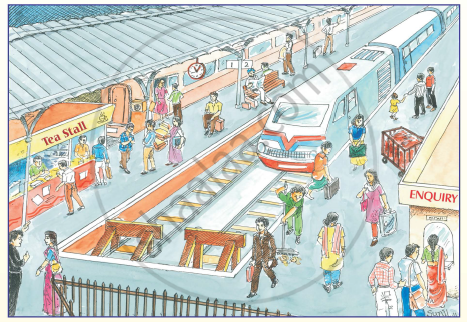
Study the following picture carefully and then write a paragraph to describe what is happening.
As Susie, write a reply to Nikita's letter. Do take care to answer all the
questions Nikita has asked you. What verb forms would you like to use?
Milan
25th October, 2011
Dear Nikita
.............................................................................................................................................
.............................................................................................................................................
.............................................................................................................................................
Yours
Susie
What has been the situation of your village/town/city five to ten years ago and how has it changed since then? Write a short paragraph describing the changes in its size, population, traftlc, buildings, lifestyle etc. Which verb forms would you mainly use to describe the changes? (Hint: Simple Past and Present Perfect forms.)
Complete the following sentences correctly by using the simple past or
past perfect forms of the given verbs.
1) We ____ already (reach) home when Irlan __ (say) that he (forget) his books at school.
2) Wendy (wake up) late, then she ____ (miss) her school bus, so by the time she (reach) school, it already (start).
3) I ___ (visit) my town again ten years after I _____ (leave) it and ___ (find) thatit completely (change).
4) When Feroze and Mehr (meet) for the first time, they ___ _ (not like) each other but now they are married.
Tenses -Summary
Read the biodata of Sangeeta Rani Puri, India's swimming sensation. Then, complete the interview in the spaces provided. Do NOT add any extra information. Use appropriate tenses.
|
Natne : Sangeeta Rani Puri Status : Non-resident Indian Place of Birth : Trinidad Place of Residence : USA Parents : Raj Krishna Puri (Father) -fatnous immigration lawyer Moyna Margaret Puri (mother) - (from Trinidad) Achievements records : i) six new national records in five day (Junior National Swimming Meet, Vijaywada) |
Interviewer: Sangeeta, since you were in India for only a short while before
you flew to Atlanta, would you tell us a little about yourself?
Sangeeta : Well, I'm an Indian and I'm proud to be one.
I: Please tell us about your parents.
S: My father ____________________
_______________________ from Trinidad.
I: Have you taken part in any of the National Championships?
S: (Very excited) Yes,_________at Vijaywada.
I: How ______________________________________________ Senior Nationals?
S: I won seven events and __________
I: How do you rate your performance in the Altanta Olympics in 1996?
S: I ___________________________ in the 50 metres freestyle. It's true that I _____________in Atlanta. But _____________________
I: Haveyou ___________________ forthefuture?
S: I in the USA. And of course I ____________for as long as possible. Also I _______________________ in the olympics.
I: Thank you, Sangeeta. I wish you all the best.
S: Thankyouverymuch.
Use the correct tense form of the verb given in the bracket and rewrite the sentence.
She ________ that old fashion book of her mother a few months back.
Use the correct tense form of the verb given in the bracket and rewrite the sentence.
One human should _______ this for another always.
Name the Tense of the Verb underlined to include Time (Past/Present/Future) and Aspect (Simple/Continuous/Perfect/Perfect Continuous).
I am fine, now.
Change the Tense as instructed.
The dots will somehow connect. (Past Perfect)
Observe the following underlined phrases. Here ‘have/has’ are followed by the past participle form of the verb. This construction indicates the present perfect tense. Find more such sentences from the text.
- We have made progress in the last couple of decades.
- We have prevented millions of child deaths.
- It has happened.
Rewrite the sentence as per the instruction given along with it.
She surveyed the area for the vicious male langur.
(Rewrite the sentence in the Simple Future Tense)
Rewrite the sentence as per the instruction given along with it.
She simply sat there quietly.
(Rewrite the sentence in the Present Continuous Tense)
Underline the verb and choose the correct option from the options.
Preeti even wrote about it.
(present tense/past tense)
Underline the verb and choose the correct option from the options.
Today Sanjay found a new book.
(present tense/past tense)
Underline the verb and choose the correct option from the options.
They are sportsmen.
(singular/plural)
Read the following sentence carefully, underline the verb and find out the tense in the sentence.
She is standing on a little high hump on the plateau.
