Advertisements
Advertisements
प्रश्न
Present Perfect vs. Simple Past
a. Explain the difference in the meaning of the following pairs of
sentences. You may like to use the given hints.
1. a. I have been a teacher for five years.
b. I was a teacher for five years.
(Hint: Is the speaker still a teacher?)
2. a. I always got good marks in English.
b. I have always got good marks in English.
(Hint: Is the speaker still studying?)
3. a. Geeta has never met her cousin.
b. Geeta never met her cousin.
(Hint: Is Geeta's cousin alive?)
4. a. I have never been to Timbuktu.
b. I never went to Timbuktu.
(Is the speaker talking about a particular journey or his travels so far?)
5. a. Jose has completed seven assignments today.
b. Jose completed seven assignments today.
(Hint: Is the day over? Has Jose more assignments to write?)
Advertisements
उत्तर
1. (a) T has been a teacher for five years.
(b) Now he is not a teacher.
2. (a) T always got good marks in English.
(b) Now ‘I’ is not studying.
3. (a) Geeta never met her cousin in her life.
(b) Geeta’s cousin is not alive.
4. (a) T has never been to Timbuktu.
(b) T is talking about his travels so far to Timbuktu.
5. (a) Jose completed seven assignments today.
(b) Jose has completed seven assignments today. He still has more assignments to write.
Note :
(a) 1. Sentence (a) shows that the speaker is still a teacher, while sentence (b) shows that the speaker is no longer a teacher.
2. Sentence (a) shows that the speaker is not studying now, while sentence (b) shows that the speaker is still studying.
3. Sentence (a) shows that Geeta’s cousin is alive, while sentence (b) shows that her cousin is not alive.
4. In sentence (a) the speaker is talking about his travels in general, whereas in sentence (b) the speaker is talking about a particular travel.
5. In sentence (a) the day is not over and Jose has some more assignments to write, while in sentence (b) the day is over and Jose has no more assignments to write.
APPEARS IN
संबंधित प्रश्न
Study the following picture carefully and then write a paragraph to describe what is happening.
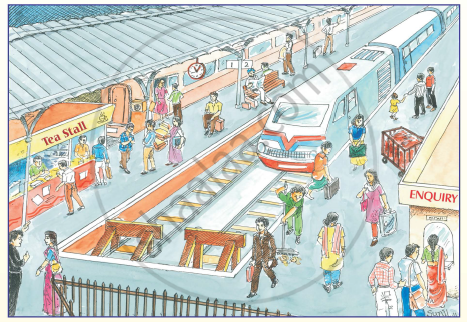
Look at the incomplete sentences below. Using the information provided, complete each sentence using a suitable tense. Follow the examples:
1947 until now India I has been (be) independent since 1947.
1947 India became (become) independent in 1947.
1. 1947 until now l There --------- (be) manywars.
2. 1991 There ------- (be) a war in the Persian Gulf.
3. 1953 -------- Edmund Hilary and Tensing first (climb) Everest.
4. 1953 until now Many people ________ (climb)Everest.
5. 1983 India --------- (win) the Prudential Cricket World Cup in England.
6. 1983 until now India -------- (win) many limited-overs cricket trophies.
As Susie, write a reply to Nikita's letter. Do take care to answer all the
questions Nikita has asked you. What verb forms would you like to use?
Milan
25th October, 2011
Dear Nikita
.............................................................................................................................................
.............................................................................................................................................
.............................................................................................................................................
Yours
Susie
The present perfect is often used with the following time expressions:
until now for many years
so far over the last few years
lately in the past few months
not yet since20xx
recently
in recent years
Choose five of these time expressions and make sentences about interesting
items of news concerning yourself.
------------------------------------------
------------------------------------------
Now make groups of four, and tell (not read) each other your news.
Study the following sentences.
1) I didn't know Jim had migrated to the United States.
2) When we arrived at the theatre, the show had already begun.
3) The patient had died before the ambulance reached the hospital.
4) He had got married by the time he started working.
5) I couldn't open the locker because I had mislaid the keys.
6) Byom Bakshi felt that he had seen the man somewhere before.
As you can see, each of the above sentences describes two different actions, events or situations. Work with a partner and list them as shown in the example.
| A. Occurred First | B. Occurred Later |
| 1. Example: Jim had migrated to the United States. | 1. I did not know it. The speaker came to know the fact later.) |
| 2. | 2. |
| 3. | 3. |
| 4. | 4. |
| 5. | 5. |
| 6. | 6. |
What verb forms have been used in (A) and (B) respectively?
A. ....................................................................
B ....................................................................
What conclusion can you draw from your analysis?
...................................................................
...................................................................
Find the incorrect sentences and then rewrite them correctly. Put a tick mark (✓)against the sentences that you think are correct.
1) By 2005, the singer recorded ten albums.
2) When I got to the bank, it had closed.
3) Timothy, the tiger, had killed five calves yesterday.
4) When Rehman met Mini ten years later, she grew up into a young girl.
5) By the time we reached the airport, the flight had left.
6) We hardly went a kilometre or so when the car broke down.
Carefully study each of the following events or situations described in a set of three sentences/phrases. Then, write a short paragraph to describe each event/situation as shown in the example. Your paragraph should begin with the description of the second event in each case. Use the verb form had+ past participle to describe the earliest of the past events.
|
• Somebody burgled the office on Sunday night. • Our arrival at work on Monday morning . • Police informed |
We arrived at work on Monday and found that somebody had burgled the office the previous night. So, we immediately informed the police. |
|
• (I) Mayank went out with his family. (ii) I tried to phone him this morning. (iii) His servant answered. |
I tried to phone Mayank this morning but the servant ........................................... ........................................... |
|
• (i) Rohit returned from holiday.(ii) Jayanti met Rohit. |
Jayanti met Rohit, who ........................................... ........................................... |
|
• (I) All the arrangements were finalised for the seminar. (ii) The seminar participants arrived in Gangtok. (iii) Met the professors from the UK the same evening. |
The participants arrived in Gangtok. They found ........................................... ........................................... |
Now write short paragraphs to describe the trends in the other groups of visitors featured in the graph.
• Overseas Visitors
....................................................
....................................................
• Domestic Visitors
....................................................
....................................................
• Total Number ofVisitors
....................................................
....................................................
Use the correct tense form of the verb given in the bracket and rewrite the sentence.
She ______ like a dressmaker’s dummy standing there.
Name the Tense of the Verb underlined to include Time (Past/Present/Future) and Aspect (Simple/Continuous/Perfect/Perfect Continuous).
I slept on the floor.
Name the Tense of the Verb underlined to include Time (Past/Present/Future) and Aspect (Simple/Continuous/Perfect/Perfect Continuous).
I am fine, now.
Change the Tense as instructed.
I got fired. (Future Perfect)
Rewrite the sentence as per the instruction given along with it.
She simply sat there quietly.
(Rewrite the sentence in the Present Continuous Tense)
Underline the verb and choose the correct option from the options.
Preeti even wrote about it.
(present tense/past tense)
Underline the verb and choose the correct option from the options.
Today Sanjay found a new book.
(present tense/past tense)
Underline the verb and choose the correct option from the options.
Rahul finds Maths easy.
(present tense/past tense)
Read the following sentence carefully, underline the verb and find out the tense in the sentence.
He leaned out eagerly.
