English

Show that the quadrilateral formed by joining the mid-points of the adjacent sides of a square is also a square. - Mathematics

Advertisements
Advertisements

Question

Show that the quadrilateral formed by joining the mid-points of the adjacent sides of a square is also a square.

Sum
Advertisements

Solution


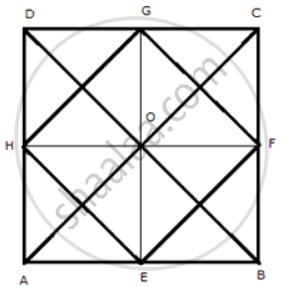
Join AC and BD

In ΔACD, G and H are the mid-points of DC and AC respectively.

Therefore, GH || AC and GH = `(1)/(2)"AC"`   ...(i)

In ΔABC, E and F are the mid-points of AB and BC respectively.

Therefore, EF || AC and EF = `(1)/(2)"AC"`   ...(ii)

From (i) and (ii)

EF || GH and EF = GH = `(1)/(2)"AC"`   ...(iii)

Similarly, it can be proved that

EF || GH and EH = GF = `(1)/(2)"BD"`   ...(iv)

But AC = BD   ...(Diagonals of a square are equal)

Dividing both sides by 2,

`(1)/(2)"BD" = (1)/(2)"AC"`

From (iii) and (iv)

EF = GH = EH = GF

Therefore, EFGH is a parallelogram.

Now in ΔGOH and ΔGOF

OH = OF   ...(Diagonals of a parallelogram bisect each other)

OG = O   ...(Common)

GH = GF

∴ ΔGOH ≅ ΔGOF

∴ ∠GOH = ∠GOF

Now, ∠GOH + ∠GOF = 180°

⇒ ∠GOH + ∠GOH = 180°

⇒ 2∠GOH = 180°

⇒ ∠GOH = 90°

Therefore, diagonals of parallelogram EFGH bisect each other and are perpendicular to each other.

Thus, EFGH is a square.

shaalaa.com
  Is there an error in this question or solution?
Chapter 15: Mid-point and Intercept Theorems - Exercise 15.1

APPEARS IN

Frank Mathematics [English] Class 9 ICSE
Chapter 15 Mid-point and Intercept Theorems
Exercise 15.1 | Q 14
Nootan Mathematics [English] Class 9 ICSE
Chapter 9 Mid-point Theorem
Exercise 9A | Q 13. | Page 195

RELATED QUESTIONS

ABC is a triangle right angled at C. A line through the mid-point M of hypotenuse AB and parallel to BC intersects AC at D. Show that

  1. D is the mid-point of AC
  2. MD ⊥ AC
  3. CM = MA = `1/2AB`

ABCD is a kite having AB = AD and BC = CD. Prove that the figure formed by joining the
mid-points of the sides, in order, is a rectangle.


Let Abc Be an Isosceles Triangle in Which Ab = Ac. If D, E, F Be the Mid-points of the Sides Bc, Ca and a B Respectively, Show that the Segment Ad and Ef Bisect Each Other at Right Angles.


Prove that the figure obtained by joining the mid-points of the adjacent sides of a rectangle is a rhombus.


Use the following figure to find:
(i) BC, if AB = 7.2 cm.
(ii) GE, if FE = 4 cm.
(iii) AE, if BD = 4.1 cm
(iv) DF, if CG = 11 cm.


The diagonals of a quadrilateral intersect each other at right angle. Prove that the figure obtained by joining the mid-points of the adjacent sides of the quadrilateral is a rectangle.


In ΔABC, X is the mid-point of AB, and Y is the mid-point of AC. BY and CX are produced and meet the straight line through A parallel to BC at P and Q respectively. Prove AP = AQ.


In a parallelogram ABCD, E and F are the midpoints of the sides AB and CD respectively. The line segments AF and BF meet the line segments DE and CE at points G and H respectively Prove that: EGFH is a parallelogram.


D, E and F are the mid-points of the sides BC, CA and AB, respectively of an equilateral triangle ABC. Show that ∆DEF is also an equilateral triangle.


P and Q are the mid-points of the opposite sides AB and CD of a parallelogram ABCD. AQ intersects DP at S and BQ intersects CP at R. Show that PRQS is a parallelogram.


Share
Notifications

Englishहिंदीमराठी


      Forgot password?
Use app×