मराठी

Show that the quadrilateral formed by joining the mid-points of the adjacent sides of a square is also a square. - Mathematics

Advertisements
Advertisements

प्रश्न

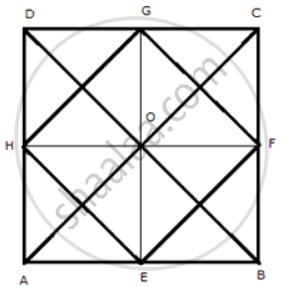
Show that the quadrilateral formed by joining the mid-points of the adjacent sides of a square is also a square.

बेरीज
Advertisements

उत्तर


Join AC and BD

In ΔACD, G and H are the mid-points of DC and AC respectively.

Therefore, GH || AC and GH = `(1)/(2)"AC"`   ...(i)

In ΔABC, E and F are the mid-points of AB and BC respectively.

Therefore, EF || AC and EF = `(1)/(2)"AC"`   ...(ii)

From (i) and (ii)

EF || GH and EF = GH = `(1)/(2)"AC"`   ...(iii)

Similarly, it can be proved that

EF || GH and EH = GF = `(1)/(2)"BD"`   ...(iv)

But AC = BD   ...(Diagonals of a square are equal)

Dividing both sides by 2,

`(1)/(2)"BD" = (1)/(2)"AC"`

From (iii) and (iv)

EF = GH = EH = GF

Therefore, EFGH is a parallelogram.

Now in ΔGOH and ΔGOF

OH = OF   ...(Diagonals of a parallelogram bisect each other)

OG = O   ...(Common)

GH = GF

∴ ΔGOH ≅ ΔGOF

∴ ∠GOH = ∠GOF

Now, ∠GOH + ∠GOF = 180°

⇒ ∠GOH + ∠GOH = 180°

⇒ 2∠GOH = 180°

⇒ ∠GOH = 90°

Therefore, diagonals of parallelogram EFGH bisect each other and are perpendicular to each other.

Thus, EFGH is a square.

shaalaa.com
  या प्रश्नात किंवा उत्तरात काही त्रुटी आहे का?
पाठ 15: Mid-point and Intercept Theorems - Exercise 15.1

APPEARS IN

फ्रँक Mathematics [English] Class 9 ICSE
पाठ 15 Mid-point and Intercept Theorems
Exercise 15.1 | Q 14
नूतन Mathematics [English] Class 9 ICSE
पाठ 9 Mid-point Theorem
Exercise 9A | Q 13. | पृष्ठ १९५

संबंधित प्रश्‍न

In parallelogram ABCD, E and F are mid-points of the sides AB and CD respectively. The line segments AF and BF meet the line segments ED and EC at points G and H respectively.
Prove that:
(i) Triangles HEB and FHC are congruent;
(ii) GEHF is a parallelogram.


In triangle ABC, D and E are points on side AB such that AD = DE = EB. Through D and E, lines are drawn parallel to BC which meet side AC at points F and G respectively. Through F and G, lines are drawn parallel to AB which meets side BC at points M and N respectively. Prove that: BM = MN = NC.


AD is a median of side BC of ABC. E is the midpoint of AD. BE is joined and produced to meet AC at F. Prove that AF: AC = 1 : 3.


ABCD is a kite in which BC = CD, AB = AD. E, F and G are the mid-points of CD, BC and AB respectively. Prove that: ∠EFG = 90°


In a parallelogram ABCD, E and F are the midpoints of the sides AB and CD respectively. The line segments AF and BF meet the line segments DE and CE at points G and H respectively Prove that: ΔHEB ≅ ΔHFC


In a parallelogram ABCD, E and F are the midpoints of the sides AB and CD respectively. The line segments AF and BF meet the line segments DE and CE at points G and H respectively Prove that: EGFH is a parallelogram.


The diagonals AC and BD of a quadrilateral ABCD intersect at right angles. Prove that the quadrilateral formed by joining the midpoints of quadrilateral ABCD is a rectangle.


P, Q, R and S are respectively the mid-points of the sides AB, BC, CD and DA of a quadrilateral ABCD in which AC = BD. Prove that PQRS is a rhombus.


P, Q, R and S are respectively the mid-points of the sides AB, BC, CD and DA of a quadrilateral ABCD such that AC ⊥ BD. Prove that PQRS is a rectangle.


P, Q, R and S are respectively the mid-points of sides AB, BC, CD and DA of quadrilateral ABCD in which AC = BD and AC ⊥ BD. Prove that PQRS is a square.


Share
Notifications

Englishहिंदीमराठी


      Forgot password?
Use app×