हिंदी

Show that the quadrilateral formed by joining the mid-points of the adjacent sides of a square is also a square. - Mathematics

Advertisements
Advertisements

प्रश्न

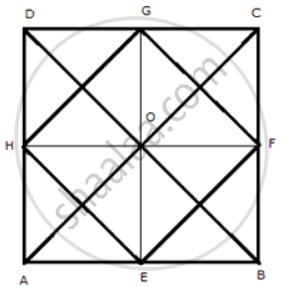
Show that the quadrilateral formed by joining the mid-points of the adjacent sides of a square is also a square.

योग
Advertisements

उत्तर


Join AC and BD

In ΔACD, G and H are the mid-points of DC and AC respectively.

Therefore, GH || AC and GH = `(1)/(2)"AC"`   ...(i)

In ΔABC, E and F are the mid-points of AB and BC respectively.

Therefore, EF || AC and EF = `(1)/(2)"AC"`   ...(ii)

From (i) and (ii)

EF || GH and EF = GH = `(1)/(2)"AC"`   ...(iii)

Similarly, it can be proved that

EF || GH and EH = GF = `(1)/(2)"BD"`   ...(iv)

But AC = BD   ...(Diagonals of a square are equal)

Dividing both sides by 2,

`(1)/(2)"BD" = (1)/(2)"AC"`

From (iii) and (iv)

EF = GH = EH = GF

Therefore, EFGH is a parallelogram.

Now in ΔGOH and ΔGOF

OH = OF   ...(Diagonals of a parallelogram bisect each other)

OG = O   ...(Common)

GH = GF

∴ ΔGOH ≅ ΔGOF

∴ ∠GOH = ∠GOF

Now, ∠GOH + ∠GOF = 180°

⇒ ∠GOH + ∠GOH = 180°

⇒ 2∠GOH = 180°

⇒ ∠GOH = 90°

Therefore, diagonals of parallelogram EFGH bisect each other and are perpendicular to each other.

Thus, EFGH is a square.

shaalaa.com
  क्या इस प्रश्न या उत्तर में कोई त्रुटि है?
अध्याय 15: Mid-point and Intercept Theorems - Exercise 15.1

APPEARS IN

फ्रैंक Mathematics [English] Class 9 ICSE
अध्याय 15 Mid-point and Intercept Theorems
Exercise 15.1 | Q 14
नूतन Mathematics [English] Class 9 ICSE
अध्याय 9 Mid-point Theorem
Exercise 9A | Q 13. | पृष्ठ १९५

संबंधित प्रश्न

In a parallelogram ABCD, E and F are the mid-points of sides AB and CD respectively (see the given figure). Show that the line segments AF and EC trisect the diagonal BD.


Fill in the blank to make the following statement correct:

The triangle formed by joining the mid-points of the sides of a right triangle is            


The figure, given below, shows a trapezium ABCD. M and N are the mid-point of the non-parallel sides AD and BC respectively. Find: 

  1. MN, if AB = 11 cm and DC = 8 cm.
  2. AB, if DC = 20 cm and MN = 27 cm.
  3. DC, if MN = 15 cm and AB = 23 cm.

The side AC of a triangle ABC is produced to point E so that CE = AC. D is the mid-point of BC and ED produced meets AB at F. Lines through D and C are drawn parallel to AB which meet AC at point P and EF at point R respectively.

Prove that:

  1. 3DF = EF
  2. 4CR = AB

ΔABC is an isosceles triangle with AB = AC. D, E and F are the mid-points of BC, AB and AC respectively. Prove that the line segment AD is perpendicular to EF and is bisected by it.


ABCD is a parallelogram.E is the mid-point of CD and P is a point on AC such that PC = `(1)/(4)"AC"`. EP produced meets BC at F. Prove that: F is the mid-point of BC.


ABCD is a kite in which BC = CD, AB = AD. E, F and G are the mid-points of CD, BC and AB respectively. Prove that: The line drawn through G and parallel to FE and bisects DA.


P, Q, R and S are respectively the mid-points of sides AB, BC, CD and DA of quadrilateral ABCD in which AC = BD and AC ⊥ BD. Prove that PQRS is a square.


E is the mid-point of a median AD of ∆ABC and BE is produced to meet AC at F. Show that AF = `1/3` AC.


Prove that the line joining the mid-points of the diagonals of a trapezium is parallel to the parallel sides of the trapezium.


Share
Notifications

Englishहिंदीमराठी


      Forgot password?
Use app×