Advertisements
Advertisements
प्रश्न
E and F are respectively the mid-points of the non-parallel sides AD and BC of a trapezium ABCD. Prove that EF || AB and EF = `1/2` (AB + CD).
[Hint: Join BE and produce it to meet CD produced at G.]
Advertisements
उत्तर
Given: ABCD is a trapezium in which AB || CD. Also, E and F are respectively the mid-points of sides AD and BC.
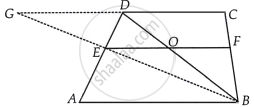
Construction: Join BE and produce it to meet CD produced at G, also draw BD which intersects EF at O.
To prove: EF || AB and EF = `1/2` (AB + CD).
Proof: In ΔGCB, E and F are respectively the mid-points of BG and BC, then by mid-point theorem,
EF || GC
But GC || AB or CD || AB ...[Given]
∴ EF || AB
In ΔADB, AB || EO and E is the mid-point of AD.
Therefore by converse of mid-point theorem, O is mid-point of BD.
Also, EO = `1/2` AB ...(i)
In ΔBDC, OF || CD and O is the mid-point of BD.
∴ OF = `1/2` CD [By converse of mid-point theorem] ...(ii)
On adding equations (i) and (ii), we get
EO + OF = `1/2` AB + `1/2` CD
⇒ EF = `1/2` (AB + CD)
Hence proved.
APPEARS IN
संबंधित प्रश्न
ABCD is a rhombus. EABF is a straight line such that EA = AB = BF. Prove that ED and FC when produced, meet at right angles.
In a ∆ABC, D, E and F are, respectively, the mid-points of BC, CA and AB. If the lengths of side AB, BC and CA are 7 cm, 8 cm and 9 cm, respectively, find the perimeter of ∆DEF.
ABCD is a quadrilateral in which AD = BC. E, F, G and H are the mid-points of AB, BD, CD and Ac respectively. Prove that EFGH is a rhombus.
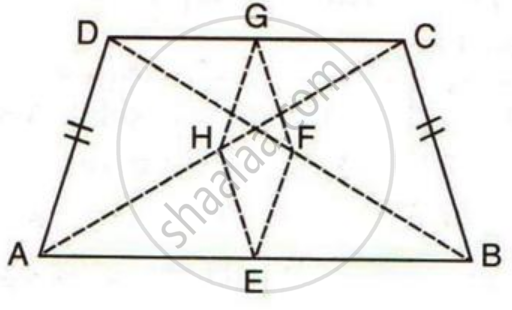
In the figure, give below, 2AD = AB, P is mid-point of AB, Q is mid-point of DR and PR // BS. Prove that:
(i) AQ // BS
(ii) DS = 3 Rs.

In the given figure, AD and CE are medians and DF // CE.
Prove that: FB = `1/4` AB.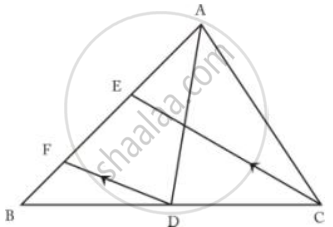
In triangle ABC, D and E are points on side AB such that AD = DE = EB. Through D and E, lines are drawn parallel to BC which meet side AC at points F and G respectively. Through F and G, lines are drawn parallel to AB which meets side BC at points M and N respectively. Prove that: BM = MN = NC.
In triangle ABC; M is mid-point of AB, N is mid-point of AC and D is any point in base BC. Use the intercept Theorem to show that MN bisects AD.
AD is a median of side BC of ABC. E is the midpoint of AD. BE is joined and produced to meet AC at F. Prove that AF: AC = 1 : 3.
In ΔABC, the medians BE and CD are produced to the points P and Q respectively such that BE = EP and CD = DQ. Prove that: Q A and P are collinear.
E is the mid-point of a median AD of ∆ABC and BE is produced to meet AC at F. Show that AF = `1/3` AC.
