Advertisements
Advertisements
प्रश्न
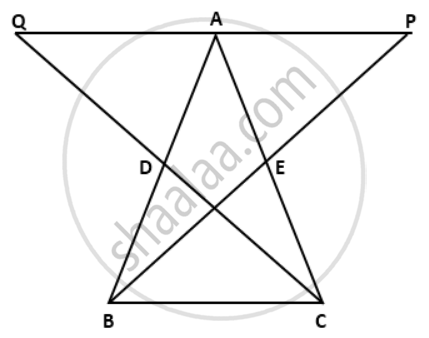
In ΔABC, the medians BE and CD are produced to the points P and Q respectively such that BE = EP and CD = DQ. Prove that: Q A and P are collinear.
Advertisements
उत्तर

In ΔBDC and ΔADQ,
CD = DQ ....(given)
∠BDC = ∠ADQ ....(vertically opposite angles)
BD = AD ....(D is the mid-point of AB)
∴ ΔBDC ≅ ΔADQ
⇒ ∠DBC = ∠DAQ (c.p.c.t)....(i)
And, BC = AQ (c.p.c.t)....(ii)
Similarly, we can prove ΔCEB ≅ ΔAEP
⇒ ∠ECB = ∠EAP (c.p.c.t)....(iii)
And, BC = AP (c.p.c.t)....(iv)
In ΔABC,
∠ABC + ∠ACB ++ ∠BAC = 180°
⇒ ∠DBC + ∠ECB + ∠BAC = 180°
⇒ ∠DAQ + ∠EAP + ∠BAC = 180° ...[From (i) and (iii)]
⇒ Q, A, P are collinear.
APPEARS IN
संबंधित प्रश्न
Show that the line segments joining the mid-points of the opposite sides of a quadrilateral
bisect each other.
In ∆ABC, E is the mid-point of the median AD, and BE produced meets side AC at point Q.
Show that BE: EQ = 3: 1.
The diagonals of a quadrilateral intersect at right angles. Prove that the figure obtained by joining the mid-points of the adjacent sides of the quadrilateral is rectangle.
D and F are midpoints of sides AB and AC of a triangle ABC. A line through F and parallel to AB meets BC at point E.
- Prove that BDFE is a parallelogram
- Find AB, if EF = 4.8 cm.
Use the following figure to find:
(i) BC, if AB = 7.2 cm.
(ii) GE, if FE = 4 cm.
(iii) AE, if BD = 4.1 cm
(iv) DF, if CG = 11 cm.

In Δ ABC, AD is the median and DE is parallel to BA, where E is a point in AC. Prove that BE is also a median.
In ΔABC, D, E, F are the midpoints of BC, CA and AB respectively. Find ∠FDB if ∠ACB = 115°.
Prove that the figure obtained by joining the mid-points of the adjacent sides of a rectangle is a rhombus.
In ΔABC, D, E and F are the midpoints of AB, BC and AC.
Show that AE and DF bisect each other.
In the given figure, PS = 3RS. M is the midpoint of QR. If TR || MN || QP, then prove that:
ST = `(1)/(3)"LS"`