Advertisements
Advertisements
प्रश्न
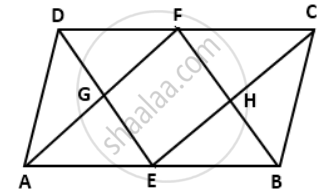
In a parallelogram ABCD, E and F are the midpoints of the sides AB and CD respectively. The line segments AF and BF meet the line segments DE and CE at points G and H respectively Prove that: EGFH is a parallelogram.
Advertisements
उत्तर

In quadrilateral AECF,
AE = CF ....[from (i)]
AE || CF ....[as AB || DC]
⇒ AECF is a parallelogram.
⇒ EC || AF or EH || GF ....(i)
In quadrilateral BFDE,
BE = DF ....[from (i)]
BE || DF ....[as AB || DC]
⇒ BEDF is a parallelogram
⇒ BF || ED or HF || EG ....(ii)
From (i) and (ii), we get that
EGFH is parallelogram.
APPEARS IN
संबंधित प्रश्न
ABCD is a rhombus and P, Q, R and S are the mid-points of the sides AB, BC, CD and DA respectively. Show that the quadrilateral PQRS is a rectangle.
In a parallelogram ABCD, E and F are the mid-points of sides AB and CD respectively (see the given figure). Show that the line segments AF and EC trisect the diagonal BD.

In below fig. ABCD is a parallelogram and E is the mid-point of side B If DE and AB when produced meet at F, prove that AF = 2AB.

BM and CN are perpendiculars to a line passing through the vertex A of a triangle ABC. If
L is the mid-point of BC, prove that LM = LN.
Show that the line segments joining the mid-points of the opposite sides of a quadrilateral
bisect each other.
Use the following figure to find:
(i) BC, if AB = 7.2 cm.
(ii) GE, if FE = 4 cm.
(iii) AE, if BD = 4.1 cm
(iv) DF, if CG = 11 cm.

In the figure, give below, 2AD = AB, P is mid-point of AB, Q is mid-point of DR and PR // BS. Prove that:
(i) AQ // BS
(ii) DS = 3 Rs.

In triangle ABC, angle B is obtuse. D and E are mid-points of sides AB and BC respectively and F is a point on side AC such that EF is parallel to AB. Show that BEFD is a parallelogram.
In ΔABC, D, E, F are the midpoints of BC, CA and AB respectively. Find FE, if BC = 14 cm
Show that the quadrilateral formed by joining the mid-points of the consecutive sides of a square is also a square.