Advertisements
Advertisements
प्रश्न
BM and CN are perpendiculars to a line passing through the vertex A of a triangle ABC. If
L is the mid-point of BC, prove that LM = LN.
Advertisements
उत्तर
To prove LM = LN
Draw LS perpendicular to line MN

∴ The lines BM, LS and CN being the same perpendiculars, on line MN are parallel to each
other.
According to intercept theorem,
If there are three or more parallel lines and the intercepts made by them on a transversal or
equal. Then the corresponding intercepts on any other transversal are also equal.
In the drawn figure, MB and LS and NC are three parallel lines and the two transversal line
are MN and BC
We have, BL= LC (As L is the given midpoint of BC)
∴ using intercept theorem, we get
MS = SN ....(i )
Now in Δ MLS and LSN
MS = SN using ….(i)
`∠`LSM = `∠`LSN = 90°LS ^ MN and SL = LS common
∴ Δ DMLS ≅ Δ LSN (SAS congruency theorem)
∴ LM = LN (CPCT )
APPEARS IN
संबंधित प्रश्न
ABCD is a square E, F, G and H are points on AB, BC, CD and DA respectively, such that AE = BF = CG = DH. Prove that EFGH is a square.
In a triangle, P, Q and R are the mid-points of sides BC, CA and AB respectively. If AC =
21 cm, BC = 29 cm and AB = 30 cm, find the perimeter of the quadrilateral ARPQ.
In a ΔABC, BM and CN are perpendiculars from B and C respectively on any line passing
through A. If L is the mid-point of BC, prove that ML = NL.
Use the following figure to find:
(i) BC, if AB = 7.2 cm.
(ii) GE, if FE = 4 cm.
(iii) AE, if BD = 4.1 cm
(iv) DF, if CG = 11 cm.

If the quadrilateral formed by joining the mid-points of the adjacent sides of quadrilateral ABCD is a rectangle,
show that the diagonals AC and BD intersect at the right angle.
In parallelogram PQRS, L is mid-point of side SR and SN is drawn parallel to LQ which meets RQ produced at N and cuts side PQ at M. Prove that M is the mid-point of PQ.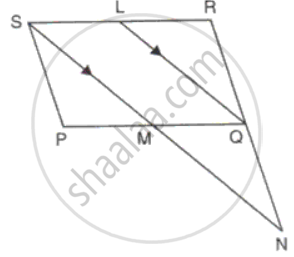
Prove that the figure obtained by joining the mid-points of the adjacent sides of a rectangle is a rhombus.
In ΔABC, D, E and F are the midpoints of AB, BC and AC.
If AE and DF intersect at G, and M and N are the midpoints of GB and GC respectively, prove that DMNF is a parallelogram.
In a parallelogram ABCD, E and F are the midpoints of the sides AB and CD respectively. The line segments AF and BF meet the line segments DE and CE at points G and H respectively Prove that: EGFH is a parallelogram.
In the given figure, PS = 3RS. M is the midpoint of QR. If TR || MN || QP, then prove that: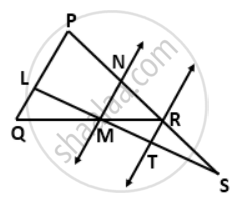
RT = `(1)/(3)"PQ"`
