Advertisements
Advertisements
प्रश्न
P, Q, R and S are respectively the mid-points of sides AB, BC, CD and DA of quadrilateral ABCD in which AC = BD and AC ⊥ BD. Prove that PQRS is a square.
Advertisements
उत्तर
Given: In quadrilateral ABCD, P, Q, R and S are the mid-points of the sides AB, BC, CD and DA, respectively.
Also, AC = BD and AC ⊥ BD.
To prove: PQRS is a square.
Proof: Now, in ΔADC, S and R are the mid-points of the sides AD and DC respectively, then by mid-point theorem,
SR || AC and SR = `1/2` AC ...(i)
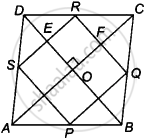
In ΔABC, P and Q are the mid-points of AB and BC, then by mid-point theorem,
PQ || AC and PQ = `1/2` AC ...(ii)
From equations (i) and (ii),
PQ || SR and PQ = SR = `1/2` AC ...(iii)
Similarly, in ΔABD, by mid-point theorem,
SP || BD and SP = `1/2` BD = `1/2` AC [Given, AC = BD] ...(iv)
And ΔBCD, by mid-point theorem,
RQ || BD and RQ = `1/2` BD = `1/2` AC [Given, BD = AC] ...(v)
From equations (iv) and (v),
SP = RQ = `1/2` AC ...(vi)
From equations (iii) and (vi),
PQ = SR = SP = RQ
Thus, all four sides are equal.
Now, in quadrilateral OERF,
OE || FR and OF || ER
∴ ∠EOF = ∠ERF = 90° ...[∵ AC ⊥ DB ⇒ ∠DOC = ∠EOF = 90° as opposite angles of a parallelogram]
∴ ∠QRS = 90°
Similarly, ∠RQS = 90°
So, PQRS is a square.
Hence proved.
APPEARS IN
संबंधित प्रश्न
ABCD is a square E, F, G and H are points on AB, BC, CD and DA respectively, such that AE = BF = CG = DH. Prove that EFGH is a square.
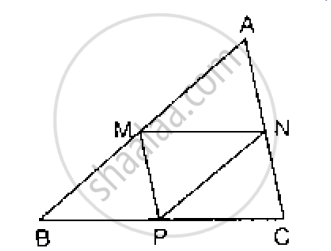
In Fig. below, M, N and P are the mid-points of AB, AC and BC respectively. If MN = 3 cm, NP = 3.5 cm and MP = 2.5 cm, calculate BC, AB and AC.
ABC is a triangle and through A, B, C lines are drawn parallel to BC, CA and AB respectively
intersecting at P, Q and R. Prove that the perimeter of ΔPQR is double the perimeter of
ΔABC
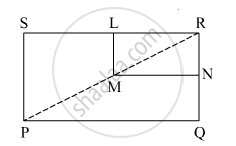
In the given figure, `square`PQRS and `square`MNRL are rectangles. If point M is the midpoint of side PR then prove that,
- SL = LR
- LN = `1/2`SQ
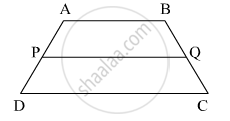
In the Figure, `square`ABCD is a trapezium. AB || DC. Points P and Q are midpoints of seg AD and seg BC respectively. Then prove that, PQ || AB and PQ = `1/2 ("AB" + "DC")`.
In triangle ABC; M is mid-point of AB, N is mid-point of AC and D is any point in base BC. Use the intercept Theorem to show that MN bisects AD.
The diagonals of a quadrilateral intersect each other at right angle. Prove that the figure obtained by joining the mid-points of the adjacent sides of the quadrilateral is a rectangle.
ΔABC is an isosceles triangle with AB = AC. D, E and F are the mid-points of BC, AB and AC respectively. Prove that the line segment AD is perpendicular to EF and is bisected by it.
P, Q, R and S are respectively the mid-points of the sides AB, BC, CD and DA of a quadrilateral ABCD in which AC = BD. Prove that PQRS is a rhombus.
E and F are respectively the mid-points of the non-parallel sides AD and BC of a trapezium ABCD. Prove that EF || AB and EF = `1/2` (AB + CD).
[Hint: Join BE and produce it to meet CD produced at G.]
