Advertisements
Advertisements
प्रश्न
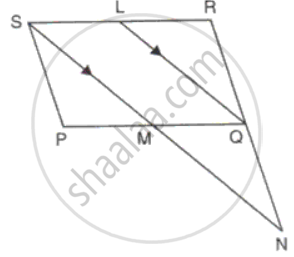
In parallelogram PQRS, L is mid-point of side SR and SN is drawn parallel to LQ which meets RQ produced at N and cuts side PQ at M. Prove that M is the mid-point of PQ.
Advertisements
उत्तर
In ΔNSR
MQ = `(1)/(2)"SR"`
But L is the mid-point of SR and SR = PQ ...(sides of a parallelogram)
MQ = `(1)/(2)"PQ"`
MQ = PM = LS = LR
Therefore, M is the mid-point of PQ.
APPEARS IN
संबंधित प्रश्न
In a ∆ABC, D, E and F are, respectively, the mid-points of BC, CA and AB. If the lengths of side AB, BC and CA are 7 cm, 8 cm and 9 cm, respectively, find the perimeter of ∆DEF.
Show that the line segments joining the mid-points of the opposite sides of a quadrilateral
bisect each other.
In triangle ABC, M is mid-point of AB and a straight line through M and parallel to BC cuts AC in N. Find the lengths of AN and MN if Bc = 7 cm and Ac = 5 cm.
In triangle ABC, D and E are points on side AB such that AD = DE = EB. Through D and E, lines are drawn parallel to BC which meet side AC at points F and G respectively. Through F and G, lines are drawn parallel to AB which meets side BC at points M and N respectively. Prove that: BM = MN = NC.
If the quadrilateral formed by joining the mid-points of the adjacent sides of quadrilateral ABCD is a rectangle,
show that the diagonals AC and BD intersect at the right angle.
In the given figure, PS = 3RS. M is the midpoint of QR. If TR || MN || QP, then prove that:
RT = `(1)/(3)"PQ"`
In ∆ABC, AB = 5 cm, BC = 8 cm and CA = 7 cm. If D and E are respectively the mid-points of AB and BC, determine the length of DE.
P, Q, R and S are respectively the mid-points of sides AB, BC, CD and DA of quadrilateral ABCD in which AC = BD and AC ⊥ BD. Prove that PQRS is a square.
Show that the quadrilateral formed by joining the mid-points of the consecutive sides of a square is also a square.
Prove that the line joining the mid-points of the diagonals of a trapezium is parallel to the parallel sides of the trapezium.
