हिंदी

D, E and F Are the Mid-points of the Sides Ab, Bc and Ca of an Isosceles δAbc in Which Ab = Bc. Prove that δDef is Also Isosceles. - Mathematics

Advertisements
Advertisements

प्रश्न

D, E and F are the mid-points of the sides AB, BC and CA of an isosceles ΔABC in which AB = BC. Prove that ΔDEF is also isosceles.

योग
Advertisements

उत्तर
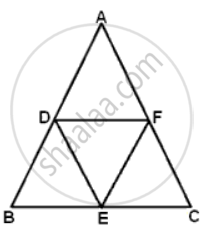

E and F are mid-points of BC and AC

Therefore, EF = `(1)/(2)"AB"`......(i)

D and F are mid-points of AB and AC

Therefore, DF = `(1)/(2)"BC"`......(ii)
But AB = BC
From (i) and (ii)
EF = DF
Therefore, ΔDEF is an isosceles triangle.

shaalaa.com
  क्या इस प्रश्न या उत्तर में कोई त्रुटि है?
अध्याय 15: Mid-point and Intercept Theorems - Exercise 15.1

APPEARS IN

फ्रैंक Mathematics [English] Class 9 ICSE
अध्याय 15 Mid-point and Intercept Theorems
Exercise 15.1 | Q 7

संबंधित प्रश्न

Fill in the blank to make the following statement correct:

The figure formed by joining the mid-points of consecutive sides of a quadrilateral is           


In the given figure, points X, Y, Z are the midpoints of side AB, side BC and side AC of ΔABC respectively. AB = 5 cm, AC = 9 cm and BC = 11 cm. Find the length of XY, YZ, XZ.


In the given figure, `square`PQRS and `square`MNRL are rectangles. If point M is the midpoint of side PR then prove that,

  1. SL = LR
  2. LN = `1/2`SQ


In triangle ABC, D and E are points on side AB such that AD = DE = EB. Through D and E, lines are drawn parallel to BC which meet side AC at points F and G respectively. Through F and G, lines are drawn parallel to AB which meets side BC at points M and N respectively. Prove that: BM = MN = NC.


In triangle ABC; M is mid-point of AB, N is mid-point of AC and D is any point in base BC. Use the intercept Theorem to show that MN bisects AD.


If the quadrilateral formed by joining the mid-points of the adjacent sides of quadrilateral ABCD is a rectangle,
show that the diagonals AC and BD intersect at the right angle.


Prove that the figure obtained by joining the mid-points of the adjacent sides of a rectangle is a rhombus.


ABCD is a parallelogram.E is the mid-point of CD and P is a point on AC such that PC = `(1)/(4)"AC"`. EP produced meets BC at F. Prove that: F is the mid-point of BC.


P, Q, R and S are respectively the mid-points of sides AB, BC, CD and DA of quadrilateral ABCD in which AC = BD and AC ⊥ BD. Prove that PQRS is a square.


Prove that the line joining the mid-points of the diagonals of a trapezium is parallel to the parallel sides of the trapezium.


Share
Notifications

Englishहिंदीमराठी


      Forgot password?
Use app×