Advertisements
Advertisements
प्रश्न
Prove that the line joining the mid-points of the diagonals of a trapezium is parallel to the parallel sides of the trapezium.
Advertisements
उत्तर
Given: Let ABCD be a trapezium in which AB || DC and let M and N be the mid-points of the diagonals AC and BD, respectively.
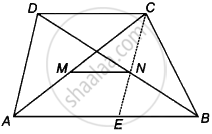
To prove: MN || AB || CD
Construction: Join CN and produce it to meet AB at E.
In ΔCDN and ΔEBN, we have
DN = BN ...[Since, N is the mid-point of BD]
∠DCN = ∠BEN ...[Alternate interior angles]
And ∠CDN = ∠EBN ...[Alternate interior angles]
∴ ΔCDN ≅ ΔEBN ...[By AAS congruence rule]
∴ DC = EB and CN = NE ...[By CPCT rule]
Thus, in ΔCAE, the points M and N are the mid-points of AC and CE, respectively.
∴ MN || AE ...[By mid-point theorem]
⇒ MN || AB || CD
Hence proved.
APPEARS IN
संबंधित प्रश्न
Show that the line segments joining the mid-points of the opposite sides of a quadrilateral bisect each other.
ABCD is a kite having AB = AD and BC = CD. Prove that the figure formed by joining the
mid-points of the sides, in order, is a rectangle.
Use the following figure to find:
(i) BC, if AB = 7.2 cm.
(ii) GE, if FE = 4 cm.
(iii) AE, if BD = 4.1 cm
(iv) DF, if CG = 11 cm.

In Δ ABC, AD is the median and DE is parallel to BA, where E is a point in AC. Prove that BE is also a median.
In the given figure, AD and CE are medians and DF // CE.
Prove that: FB = `1/4` AB.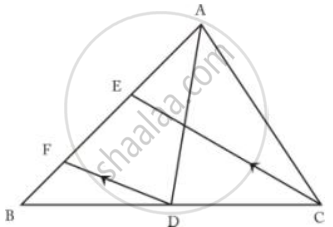
In ΔABC, D, E, F are the midpoints of BC, CA and AB respectively. Find DE, if AB = 8 cm
The diagonals of a quadrilateral intersect each other at right angle. Prove that the figure obtained by joining the mid-points of the adjacent sides of the quadrilateral is a rectangle.
E is the mid-point of the side AD of the trapezium ABCD with AB || DC. A line through E drawn parallel to AB intersect BC at F. Show that F is the mid-point of BC. [Hint: Join AC]
P, Q, R and S are respectively the mid-points of sides AB, BC, CD and DA of quadrilateral ABCD in which AC = BD and AC ⊥ BD. Prove that PQRS is a square.
E and F are respectively the mid-points of the non-parallel sides AD and BC of a trapezium ABCD. Prove that EF || AB and EF = `1/2` (AB + CD).
[Hint: Join BE and produce it to meet CD produced at G.]
