Advertisements
Advertisements
Question
Prove that the line joining the mid-points of the diagonals of a trapezium is parallel to the parallel sides of the trapezium.
Advertisements
Solution
Given: Let ABCD be a trapezium in which AB || DC and let M and N be the mid-points of the diagonals AC and BD, respectively.
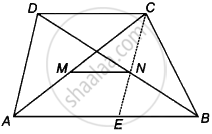
To prove: MN || AB || CD
Construction: Join CN and produce it to meet AB at E.
In ΔCDN and ΔEBN, we have
DN = BN ...[Since, N is the mid-point of BD]
∠DCN = ∠BEN ...[Alternate interior angles]
And ∠CDN = ∠EBN ...[Alternate interior angles]
∴ ΔCDN ≅ ΔEBN ...[By AAS congruence rule]
∴ DC = EB and CN = NE ...[By CPCT rule]
Thus, in ΔCAE, the points M and N are the mid-points of AC and CE, respectively.
∴ MN || AE ...[By mid-point theorem]
⇒ MN || AB || CD
Hence proved.
APPEARS IN
RELATED QUESTIONS
Show that the line segments joining the mid-points of the opposite sides of a quadrilateral
bisect each other.
Prove that the figure obtained by joining the mid-points of the adjacent sides of a rectangle is a rhombus.
The following figure shows a trapezium ABCD in which AB // DC. P is the mid-point of AD and PR // AB. Prove that:
PR = `[1]/[2]` ( AB + CD)

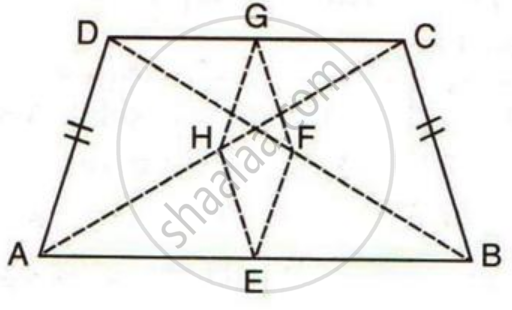
ABCD is a quadrilateral in which AD = BC. E, F, G and H are the mid-points of AB, BD, CD and Ac respectively. Prove that EFGH is a rhombus.
In triangle ABC; M is mid-point of AB, N is mid-point of AC and D is any point in base BC. Use the intercept Theorem to show that MN bisects AD.
Prove that the figure obtained by joining the mid-points of the adjacent sides of a rectangle is a rhombus.
AD is a median of side BC of ABC. E is the midpoint of AD. BE is joined and produced to meet AC at F. Prove that AF: AC = 1 : 3.
The quadrilateral formed by joining the mid-points of the sides of a quadrilateral PQRS, taken in order, is a rhombus, if ______.
P, Q, R and S are respectively the mid-points of sides AB, BC, CD and DA of quadrilateral ABCD in which AC = BD and AC ⊥ BD. Prove that PQRS is a square.
E and F are respectively the mid-points of the non-parallel sides AD and BC of a trapezium ABCD. Prove that EF || AB and EF = `1/2` (AB + CD).
[Hint: Join BE and produce it to meet CD produced at G.]
