Advertisements
Advertisements
Question
D, E and F are respectively the mid-points of the sides AB, BC and CA of a triangle ABC. Prove that by joining these mid-points D, E and F, the triangles ABC is divided into four congruent triangles.
Advertisements
Solution
Given: In a ΔABC, D, E and F are respectively the mid-points of the sides AB, BC and CA.
To prove: ΔABC is divided into four congruent triangles.
Proof: Since, ABC is a triangle and D, E and F are the mid-points of sides AB, BC and CA, respectively.

Then, AD = BD = `1/2`AB, BE = EC = `1/2`BC
And AF = CF = `1/2`AC
Now, using the mid-point theorem,
EF || AB and EF = `1/2`AB = AD = BD
ED || AC and ED = `1/2`AC = AF = CF
And DF || BC and DF = `1/2`BC = BE = CE
In ΔADF and ΔEFD,
AD = EF
AF = DE
And DF = FD ...[Common]
∴ ΔADF ≅ ΔEFD ...[By SSS congruence rule]
Similarly, ΔDEF ≅ ΔEDB
And ΔDEF ≅ ΔCFE
So, ΔABC is divided into four congruent triangles.
Hence proved.
APPEARS IN
RELATED QUESTIONS
In a triangle ∠ABC, ∠A = 50°, ∠B = 60° and ∠C = 70°. Find the measures of the angles of
the triangle formed by joining the mid-points of the sides of this triangle.
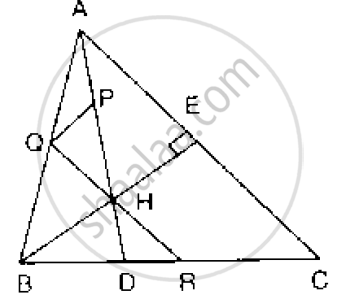
In Fig. below, BE ⊥ AC. AD is any line from A to BC intersecting BE in H. P, Q and R are
respectively the mid-points of AH, AB and BC. Prove that ∠PQR = 90°.
In triangle ABC, angle B is obtuse. D and E are mid-points of sides AB and BC respectively and F is a point on side AC such that EF is parallel to AB. Show that BEFD is a parallelogram.
In triangle ABC, D and E are points on side AB such that AD = DE = EB. Through D and E, lines are drawn parallel to BC which meet side AC at points F and G respectively. Through F and G, lines are drawn parallel to AB which meets side BC at points M and N respectively. Prove that: BM = MN = NC.
In triangle ABC; M is mid-point of AB, N is mid-point of AC and D is any point in base BC. Use the intercept Theorem to show that MN bisects AD.
ABCD is a kite in which BC = CD, AB = AD. E, F and G are the mid-points of CD, BC and AB respectively. Prove that: ∠EFG = 90°
In a parallelogram ABCD, E and F are the midpoints of the sides AB and CD respectively. The line segments AF and BF meet the line segments DE and CE at points G and H respectively Prove that: ΔGEA ≅ ΔGFD
In ΔABC, the medians BE and CD are produced to the points P and Q respectively such that BE = EP and CD = DQ. Prove that: A is the mid-point of PQ.
The diagonals AC and BD of a quadrilateral ABCD intersect at right angles. Prove that the quadrilateral formed by joining the midpoints of quadrilateral ABCD is a rectangle.
In ΔABC, D and E are the midpoints of the sides AB and BC respectively. F is any point on the side AC. Also, EF is parallel to AB. Prove that BFED is a parallelogram.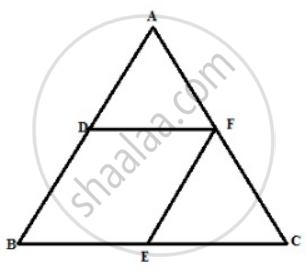
Remark: Figure is incorrect in Question
