Advertisements
Advertisements
Question
The figure formed by joining the mid-points of the sides of a quadrilateral ABCD, taken in order, is a square only if, ______.
Options
ABCD is a rhombus
diagonals of ABCD are equal
diagonals of ABCD are equal and perpendicular
diagonals of ABCD are perpendicular
Advertisements
Solution
The figure formed by joining the mid-points of the sides of a quadrilateral ABCD, taken in order, is a square only if, diagonals of ABCD are equal and perpendicular.
Explanation:
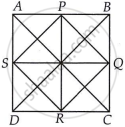
Given, ABCD is a quadrilateral and P, Q, R and S are the mid-points of sides of AB, BC, CD and DA, respectively.
Then, PQRS is a square.
∴ PQ = QR = RS = PS ...(i)
And PR = SQ
But PR = BC and SQ = AB
∴ AB = BC
Thus, all the sides of quadrilateral ABCD are equal.
Hence, quadrilateral ABCD is either a square or a rhombus.
Now, in ΔADB, use mid-point theorem
SP || DB
And SP = `1/2` DB ...(ii)
Similarly in ΔABC ...(By mid-point theorem)
PQ || AC and PQ = `1/2` AC ...(iii)
From equation (i),
PS = PQ
⇒ `1/2` DB = `1/2` AC ...[From equations (ii) and (iii)]
⇒ DB = AC
Thus, diagonals of ABCD are equal and therefore quadrilateral ABCD is a square not rhombus. So, diagonals of quadrilateral are also perpendicular.
APPEARS IN
RELATED QUESTIONS
Show that the line segments joining the mid-points of the opposite sides of a quadrilateral bisect each other.
In a triangle ∠ABC, ∠A = 50°, ∠B = 60° and ∠C = 70°. Find the measures of the angles of
the triangle formed by joining the mid-points of the sides of this triangle.
In parallelogram ABCD, E and F are mid-points of the sides AB and CD respectively. The line segments AF and BF meet the line segments ED and EC at points G and H respectively.
Prove that:
(i) Triangles HEB and FHC are congruent;
(ii) GEHF is a parallelogram.
Prove that the figure obtained by joining the mid-points of the adjacent sides of a rectangle is a rhombus.
In a parallelogram ABCD, M is the mid-point AC. X and Y are the points on AB and DC respectively such that AX = CY. Prove that:
(i) Triangle AXM is congruent to triangle CYM, and
(ii) XMY is a straight line.
In the given figure, ABCD is a trapezium. P and Q are the midpoints of non-parallel side AD and BC respectively. Find: AB, if DC = 8 cm and PQ = 9.5 cm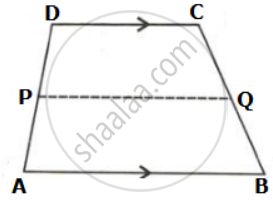
In ΔABC, D, E and F are the midpoints of AB, BC and AC.
Show that AE and DF bisect each other.
In ΔABC, D and E are the midpoints of the sides AB and BC respectively. F is any point on the side AC. Also, EF is parallel to AB. Prove that BFED is a parallelogram.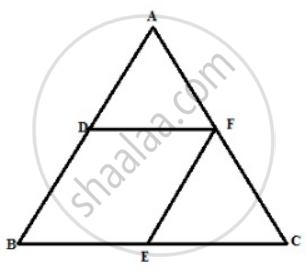
Remark: Figure is incorrect in Question
P, Q, R and S are respectively the mid-points of the sides AB, BC, CD and DA of a quadrilateral ABCD in which AC = BD. Prove that PQRS is a rhombus.
P, Q, R and S are respectively the mid-points of sides AB, BC, CD and DA of quadrilateral ABCD in which AC = BD and AC ⊥ BD. Prove that PQRS is a square.
