Advertisements
Advertisements
Question
The quadrilateral formed by joining the mid-points of the sides of a quadrilateral PQRS, taken in order, is a rhombus, if ______.
Options
PQRS is a rhombus
PQRS is a parallelogram
diagonals of PQRS are perpendicular
diagonals of PQRS are equal
Advertisements
Solution
The quadrilateral formed by joining the mid-points of the sides of a quadrilateral PQRS, taken in order, is a rhombus, if diagonals of PQRS are equal.
Explanation:
Given, the quadrilateral ABCD is a rhombus.
So, sides AB, BC, CD and AD are equal.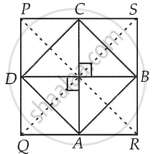
Now, in ΔPQS, we have
D and C are the mid-points of PQ and PS.
So, `DC = 1/2 QS` [By mid-point theorem] ...(i)
Similarly, in ΔPSR, `BC = 1/2 PR` [By mid-point theorem] ...(ii)
As BC = DC ...[Since, ABCD is a rhombus]
∴ `1/2 QS = 1/2 PR` ...[From equations (i) and (ii)]
⇒ QS = PR
Hence, diagonals of PQRS are equal.
APPEARS IN
RELATED QUESTIONS
ABCD is a kite having AB = AD and BC = CD. Prove that the figure formed by joining the
mid-points of the sides, in order, is a rectangle.
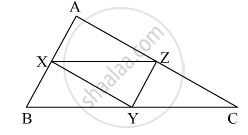
In the given figure, points X, Y, Z are the midpoints of side AB, side BC and side AC of ΔABC respectively. AB = 5 cm, AC = 9 cm and BC = 11 cm. Find the length of XY, YZ, XZ.
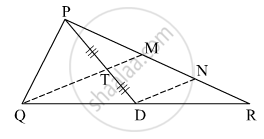
In the given figure, seg PD is a median of ΔPQR. Point T is the mid point of seg PD. Produced QT intersects PR at M. Show that `"PM"/"PR" = 1/3`.
[Hint: DN || QM]
In triangle ABC, the medians BP and CQ are produced up to points M and N respectively such that BP = PM and CQ = QN. Prove that:
- M, A, and N are collinear.
- A is the mid-point of MN.
In triangle ABC, angle B is obtuse. D and E are mid-points of sides AB and BC respectively and F is a point on side AC such that EF is parallel to AB. Show that BEFD is a parallelogram.
Prove that the figure obtained by joining the mid-points of the adjacent sides of a rectangle is a rhombus.
In ΔABC, P is the mid-point of BC. A line through P and parallel to CA meets AB at point Q, and a line through Q and parallel to BC meets median AP at point R. Prove that: BC = 4QR
Side AC of a ABC is produced to point E so that CE = `(1)/(2)"AC"`. D is the mid-point of BC and ED produced meets AB at F. Lines through D and C are drawn parallel to AB which meets AC at point P and EF at point R respectively. Prove that: 3DF = EF
ABCD is a kite in which BC = CD, AB = AD. E, F and G are the mid-points of CD, BC and AB respectively. Prove that: ∠EFG = 90°
In ΔABC, D and E are the midpoints of the sides AB and BC respectively. F is any point on the side AC. Also, EF is parallel to AB. Prove that BFED is a parallelogram.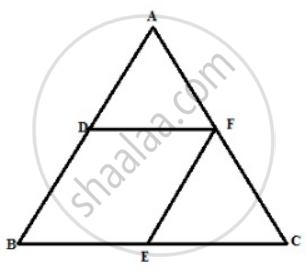
Remark: Figure is incorrect in Question
