Advertisements
Advertisements
Question
P, Q, R and S are respectively the mid-points of the sides AB, BC, CD and DA of a quadrilateral ABCD in which AC = BD. Prove that PQRS is a rhombus.
Advertisements
Solution
Given: In a quadrilateral ABCD, P, Q, R and S are the mid-points of sides AB, BC, CD and DA, respectively.
Also, AC = BD
To prove: PQRS is a rhombus.
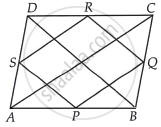
Proof: In ΔADC, S and R are the mid-points of AD and DC respectively.
Then, by mid-point theorem.
SR || AC and SR = `1/2` AC ...(i)
In ΔABC, P and Q are the mid-points of AB and BC respectively.
Then, by mid-point theorem.
PQ || AC and PQ = `1/2` AC ...(ii)
From equations (i) and (ii),
SR = PQ = `1/2` AC ...(iii)
Similarly, in ΔBCD,
RQ || BD and RQ = `1/2` BD ...(iv)
And in ΔBAD,
SP || BD and SP = `1/2` BD ...(v)
From equations (iv) and (v),
SP = RQ = `1/2` BD = `1/2` AC [Given, AC = BD] ...(vi)
From equations (iii) and (vi),
SR = PQ = SP = RQ
It shows that all sides of a quadrilateral PQRS are equal.
Hence, PQRS is a rhombus.
APPEARS IN
RELATED QUESTIONS
ABCD is a quadrilateral in which P, Q, R and S are mid-points of the sides AB, BC, CD and DA (see the given figure). AC is a diagonal. Show that:
- SR || AC and SR = `1/2AC`
- PQ = SR
- PQRS is a parallelogram.

ABCD is a rectangle and P, Q, R and S are mid-points of the sides AB, BC, CD and DA respectively. Show that the quadrilateral PQRS is a rhombus.
ABC is a triangle right angled at C. A line through the mid-point M of hypotenuse AB and parallel to BC intersects AC at D. Show that
- D is the mid-point of AC
- MD ⊥ AC
- CM = MA = `1/2AB`
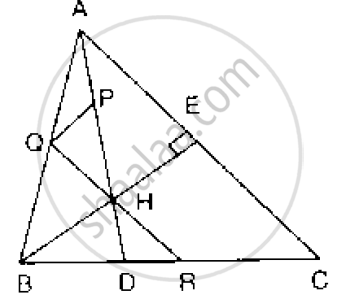
In Fig. below, BE ⊥ AC. AD is any line from A to BC intersecting BE in H. P, Q and R are
respectively the mid-points of AH, AB and BC. Prove that ∠PQR = 90°.
Let Abc Be an Isosceles Triangle in Which Ab = Ac. If D, E, F Be the Mid-points of the Sides Bc, Ca and a B Respectively, Show that the Segment Ad and Ef Bisect Each Other at Right Angles.
Show that the line segments joining the mid-points of the opposite sides of a quadrilateral
bisect each other.
If L and M are the mid-points of AB, and DC respectively of parallelogram ABCD. Prove that segment DL and BM trisect diagonal AC.
AD is a median of side BC of ABC. E is the midpoint of AD. BE is joined and produced to meet AC at F. Prove that AF: AC = 1 : 3.
In ΔABC, D, E and F are the midpoints of AB, BC and AC.
Show that AE and DF bisect each other.
In ΔABC, the medians BE and CD are produced to the points P and Q respectively such that BE = EP and CD = DQ. Prove that: Q A and P are collinear.
