English

In the Given Figure, Ps = 3rs. M is the Midpoint of Qr. If Tr || Mn || Qp, Then Prove That:Rt = 1 3 Pq

Advertisements
Advertisements

Question

In the given figure, PS = 3RS. M is the midpoint of QR. If TR || MN || QP, then prove that:
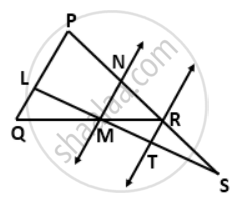
RT = `(1)/(3)"PQ"`

Sum
Advertisements

Solution

Proof:
R and T are the mid-points of NS and MS respectively.

⇒ RT = `(1)/(2)"MN"`

M and N are the mid-points of  LT and PR respectively.

⇒ MN = `(1)/(2)"PQ"`

So, RT = `(1)/(2)(1/2 "PQ")`

⇒ RT = `(1)/(4)"PQ"`.

shaalaa.com
  Is there an error in this question or solution?
Chapter 15: Mid-point and Intercept Theorems - Exercise 15.2

APPEARS IN

Frank Mathematics [English] Class 9 ICSE
Chapter 15 Mid-point and Intercept Theorems
Exercise 15.2 | Q 8.2

RELATED QUESTIONS

In a triangle, P, Q and R are the mid-points of sides BC, CA and AB respectively. If AC =
21 cm, BC = 29 cm and AB = 30 cm, find the perimeter of the quadrilateral ARPQ.


ABCD is a kite having AB = AD and BC = CD. Prove that the figure formed by joining the
mid-points of the sides, in order, is a rectangle.


BM and CN are perpendiculars to a line passing through the vertex A of a triangle ABC. If
L is the mid-point of BC, prove that LM = LN.


In the given figure, ΔABC is an equilateral traingle. Points F, D and E are midpoints of side AB, side BC, side AC respectively. Show that ΔFED is an equilateral traingle.


D, E, and F are the mid-points of the sides AB, BC and CA of an isosceles ΔABC in which AB = BC.

Prove that ΔDEF is also isosceles.


In trapezium ABCD, sides AB and DC are parallel to each other. E is mid-point of AD and F is mid-point of BC.
Prove that: AB + DC = 2EF.


Side AC of a ABC is produced to point E so that CE = `(1)/(2)"AC"`. D is the mid-point of BC and ED produced meets AB at F. Lines through D and C are drawn parallel to AB which meets AC at point P and EF at point R respectively. Prove that: 4CR = AB.


ABCD is a parallelogram.E is the mid-point of CD and P is a point on AC such that PC = `(1)/(4)"AC"`. EP produced meets BC at F. Prove that: F is the mid-point of BC.


In ∆ABC, AB = 5 cm, BC = 8 cm and CA = 7 cm. If D and E are respectively the mid-points of AB and BC, determine the length of DE.


P and Q are the mid-points of the opposite sides AB and CD of a parallelogram ABCD. AQ intersects DP at S and BQ intersects CP at R. Show that PRQS is a parallelogram.


Share
Notifications

Englishहिंदीमराठी


      Forgot password?
Use app×