Advertisements
Advertisements
Question
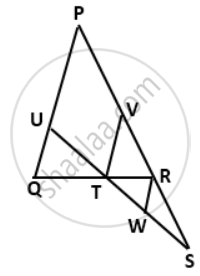
In the given figure, T is the midpoint of QR. Side PR of ΔPQR is extended to S such that R divides PS in the ratio 2:1. TV and WR are drawn parallel to PQ. Prove that T divides SU in the ratio 2:1 and WR = `(1)/(4)"PQ"`.
Advertisements
Solution
In ΔPQR,
T is the mid-point of QR and VT || PQ
So, V is the mid-point of PR.
Since R divides PR in the ratio 2 : 1 and PV = VR,
so, PV = PR = RS
Since R is the mid-point of SV and RW || VT,
W is the mid-point of ST.
Since V is the mid-point of PR and VT || PQ,
T is the mid-point of UW.
So, UT = TW = SW
⇒ T divides SU in the ratio 2 : 1
Also,
R and W are the midpoints SV and TS respectively.
⇒ WR = `(1)/(2)"VT"`
V and T are the mid-points of PR and UW respectively.
⇒ VT = `(1)/(2)"PQ"`
So, WR = `(1)/(2)(1/2 "PQ")`
⇒ WR = `(1)/(4)"PQ"`.
APPEARS IN
RELATED QUESTIONS
ABC is a triangle and through A, B, C lines are drawn parallel to BC, CA and AB respectively
intersecting at P, Q and R. Prove that the perimeter of ΔPQR is double the perimeter of
ΔABC
In the Figure, `square`ABCD is a trapezium. AB || DC. Points P and Q are midpoints of seg AD and seg BC respectively. Then prove that, PQ || AB and PQ = `1/2 ("AB" + "DC")`.

The figure, given below, shows a trapezium ABCD. M and N are the mid-point of the non-parallel sides AD and BC respectively. Find:

- MN, if AB = 11 cm and DC = 8 cm.
- AB, if DC = 20 cm and MN = 27 cm.
- DC, if MN = 15 cm and AB = 23 cm.
Prove that the straight lines joining the mid-points of the opposite sides of a quadrilateral bisect each other.
In a right-angled triangle ABC. ∠ABC = 90° and D is the midpoint of AC. Prove that BD = `(1)/(2)"AC"`.
Show that the quadrilateral formed by joining the mid-points of the adjacent sides of a square is also a square.
In the given figure, ABCD is a trapezium. P and Q are the midpoints of non-parallel side AD and BC respectively. Find: DC, if AB = 20 cm and PQ = 14 cm
In ΔABC, D, E and F are the midpoints of AB, BC and AC.
If AE and DF intersect at G, and M and N are the midpoints of GB and GC respectively, prove that DMNF is a parallelogram.
In ΔABC, D and E are the midpoints of the sides AB and AC respectively. F is any point on the side BC. If DE intersects AF at P show that DP = PE.
D, E and F are the mid-points of the sides BC, CA and AB, respectively of an equilateral triangle ABC. Show that ∆DEF is also an equilateral triangle.
