English

In the Given Figure, Abcd is a Trapezium. P and Q Are the Midpoints of Non-parallel Side Ad and Bc Respectively. Find: Dc, If Ab = 20 Cm and Pq = 14 Cm - Mathematics

Advertisements
Advertisements

Question

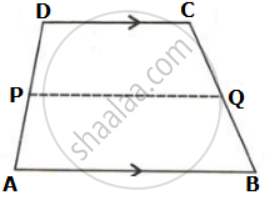
In the given figure, ABCD is a trapezium. P and Q are the midpoints of non-parallel side AD and BC respectively. Find: DC, if AB = 20 cm and PQ = 14 cm
Sum
Advertisements

Solution

Let us draw a diagonal AC which meets PQ at O as shown below:
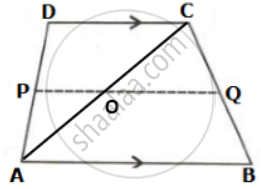
Given AB = 20 cm and PQ = 14 cm
In ΔABC,

OQ = `(1)/(2)"AB"`     ....(Mid-point Theorem)

⇒ OP = `(1)/(2) xx 20` = 10 cm

Now, 
OP = PQ - OQ
⇒ OP = 14 - 10
= 4 cm

In ΔADC,

OP = `(1)/(2)"DC"`    ....(Mid-point Theorem)

⇒ DC = 2 x OP
= 2 x 4 
= 8 cm.

shaalaa.com
  Is there an error in this question or solution?
Chapter 15: Mid-point and Intercept Theorems - Exercise 15.1

APPEARS IN

Frank Mathematics [English] Class 9 ICSE
Chapter 15 Mid-point and Intercept Theorems
Exercise 15.1 | Q 15.3

RELATED QUESTIONS

ABCD is a rectangle and P, Q, R and S are mid-points of the sides AB, BC, CD and DA respectively. Show that the quadrilateral PQRS is a rhombus.


In the given figure, ΔABC is an equilateral traingle. Points F, D and E are midpoints of side AB, side BC, side AC respectively. Show that ΔFED is an equilateral traingle.


ABCD is a quadrilateral in which AD = BC. E, F, G and H are the mid-points of AB, BD, CD and Ac respectively. Prove that EFGH is a rhombus.


In triangle ABC, the medians BP and CQ are produced up to points M and N respectively such that BP = PM and CQ = QN. Prove that:

  1. M, A, and N are collinear.
  2. A is the mid-point of MN.

D, E and F are the mid-points of the sides AB, BC and CA of an isosceles ΔABC in which AB = BC. Prove that ΔDEF is also isosceles.


Side AC of a ABC is produced to point E so that CE = `(1)/(2)"AC"`. D is the mid-point of BC and ED produced meets AB at F. Lines through D and C are drawn parallel to AB which meets AC at point P and EF at point R respectively. Prove that: 4CR = AB.


In ΔABC, D, E and F are the midpoints of AB, BC and AC.
Show that AE and DF bisect each other.


In the given figure, T is the midpoint of QR. Side PR of ΔPQR is extended to S such that R divides PS in the ratio 2:1. TV and WR are drawn parallel to PQ. Prove that T divides SU in the ratio 2:1 and WR = `(1)/(4)"PQ"`.


D, E and F are the mid-points of the sides BC, CA and AB, respectively of an equilateral triangle ABC. Show that ∆DEF is also an equilateral triangle.


P, Q, R and S are respectively the mid-points of sides AB, BC, CD and DA of quadrilateral ABCD in which AC = BD and AC ⊥ BD. Prove that PQRS is a square.


Share
Notifications

Englishहिंदीमराठी


      Forgot password?
Use app×