English

In δAbc, P is the Mid-point of Bc. a Line Through P and Parallel to Ca Meets Ab at Point Q, and a Line Through Q and Parallel to Bc Meets Median Ap at Point R. Prove That: Ap = 2ar - Mathematics

Advertisements
Advertisements

Question

In ΔABC, P is the mid-point of BC. A line through P and parallel to CA meets AB at point Q, and a line through Q and parallel to BC meets median AP at point R. Prove that: AP = 2AR

Sum
Advertisements

Solution
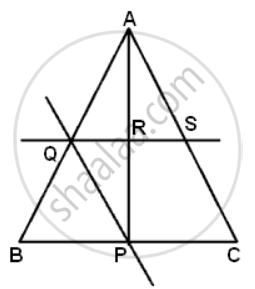

In ΔABC,
P is the mid-point of BC and PQ is parallel to AC
Therefore, Q is the mid-point of AB.
In ΔABP,
Q is the mid-point of AB and QR is parallel to BP
Therefore, R is the mid-point of AP.
AR = RP
But AR + RP = AP
⇒ AR + AR = AP
⇒ 2AR = AP or AP = 2AR.

shaalaa.com
  Is there an error in this question or solution?
Chapter 15: Mid-point and Intercept Theorems - Exercise 15.1

APPEARS IN

Frank Mathematics [English] Class 9 ICSE
Chapter 15 Mid-point and Intercept Theorems
Exercise 15.1 | Q 16.1

RELATED QUESTIONS

Show that the line segments joining the mid-points of the opposite sides of a quadrilateral bisect each other.


ABCD is a parallelogram, E and F are the mid-points of AB and CD respectively. GH is any line intersecting AD, EF and BC at G, P and H respectively. Prove that GP = PH.


In the adjacent figure, `square`ABCD is a trapezium AB || DC. Points M and N are midpoints of diagonal AC and DB respectively then prove that MN || AB.


L and M are the mid-point of sides AB and DC respectively of parallelogram ABCD. Prove that segments DL and BM trisect diagonal AC.


ABCD is a quadrilateral in which AD = BC. E, F, G and H are the mid-points of AB, BD, CD and Ac respectively. Prove that EFGH is a rhombus.


In parallelogram PQRS, L is mid-point of side SR and SN is drawn parallel to LQ which meets RQ produced at N and cuts side PQ at M. Prove that M is the mid-point of PQ.


In the given figure, ABCD is a trapezium. P and Q are the midpoints of non-parallel side AD and BC respectively. Find: PQ, if AB = 12 cm and DC = 10 cm.


ABCD is a kite in which BC = CD, AB = AD. E, F and G are the mid-points of CD, BC and AB respectively. Prove that: ∠EFG = 90°


In AABC, D and E are two points on the side AB such that AD = DE = EB. Through D and E, lines are drawn parallel to BC which meet the side AC at points F and G respectively. Through F and G, lines are drawn parallel to AB which meet the side BC at points M and N respectively. Prove that BM = MN = NC.


In ∆ABC, AB = 5 cm, BC = 8 cm and CA = 7 cm. If D and E are respectively the mid-points of AB and BC, determine the length of DE.


Share
Notifications

Englishहिंदीमराठी


      Forgot password?
Use app×