English

A Parallelogram Abcd Has P the Mid-point of Dc and Q a Point of Ac Such that Cq = 1 4 Ac Pq Produced Meets Bc at R Prove that R is the Midpoint of Bc Pr = 12 Db - Mathematics

Advertisements
Advertisements

Question

A parallelogram ABCD has P the mid-point of Dc and Q a point of Ac such that

CQ = `[1]/[4]`AC. PQ produced meets BC at R.

Prove that
(i)R is the midpoint of BC
(ii) PR = `[1]/[2]` DB

Sum
Advertisements

Solution

For help, we draw the diagonal BD as shown below
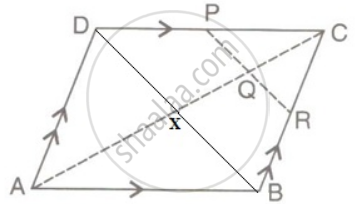
The diagonal AC and BD cuts at point X.

We know that the diagonal of a parallelogram intersect equally with each other. Therefore

AX = CX and BX = DX

Given,
CQ = `[1]/[4]`AC

CQ = `[1]/[4]` x 2CX

CQ = `[1]/[2]`CX

Therefore Q is the midpoint of CX.

(i) For triangle CDX PQ || DX or PR || BD
Since for triangle CBX
Q is the midpoint of CX and QR || BX. Therefore R is the midpoint of BC

(ii) For triangle BCD
As P and R are the mid-point of CD and BC, therefore  PR = `[1]/[2]` DB

shaalaa.com
  Is there an error in this question or solution?
Chapter 12: Mid-point and Its Converse [ Including Intercept Theorem] - Exercise 12 (A) [Page 150]

APPEARS IN

Selina Concise Mathematics [English] Class 9 ICSE
Chapter 12 Mid-point and Its Converse [ Including Intercept Theorem]
Exercise 12 (A) | Q 9 | Page 150

RELATED QUESTIONS

In a triangle ∠ABC, ∠A = 50°, ∠B = 60° and ∠C = 70°. Find the measures of the angles of

the triangle formed by joining the mid-points of the sides of this triangle. 


In a ΔABC, E and F are the mid-points of AC and AB respectively. The altitude AP to BC
intersects FE at Q. Prove that AQ = QP.


In a ΔABC, BM and CN are perpendiculars from B and C respectively on any line passing
through A. If L is the mid-point of BC, prove that ML = NL.


In the given figure, seg PD is a median of ΔPQR. Point T is the mid point of seg PD. Produced QT intersects PR at M. Show that `"PM"/"PR" = 1/3`.

[Hint: DN || QM]


In trapezium ABCD, AB is parallel to DC; P and Q are the mid-points of AD and BC respectively. BP produced meets CD produced at point E.

Prove that:

  1. Point P bisects BE,
  2. PQ is parallel to AB.

In triangle ABC, P is the mid-point of side BC. A line through P and parallel to CA meets AB at point Q, and a line through Q and parallel to BC meets median AP at point R.
Prove that : (i) AP = 2AR
                   (ii) BC = 4QR


In the given figure, ABCD is a trapezium. P and Q are the midpoints of non-parallel side AD and BC respectively. Find: PQ, if AB = 12 cm and DC = 10 cm.


Side AC of a ABC is produced to point E so that CE = `(1)/(2)"AC"`. D is the mid-point of BC and ED produced meets AB at F. Lines through D and C are drawn parallel to AB which meets AC at point P and EF at point R respectively. Prove that: 4CR = AB.


AD is a median of side BC of ABC. E is the midpoint of AD. BE is joined and produced to meet AC at F. Prove that AF: AC = 1 : 3.


The figure obtained by joining the mid-points of the sides of a rhombus, taken in order, is ______.


Share
Notifications

Englishहिंदीमराठी


      Forgot password?
Use app×