English

D, E and F Are the Mid-points of the Sides Ab, Bc and Ca Respectively of δAbc. Ae Meets Df at O. P and Q Are the Mid-points of Ob and Oc Respectively. Prove that Dpqf is a Parallelogram

Advertisements
Advertisements

Question

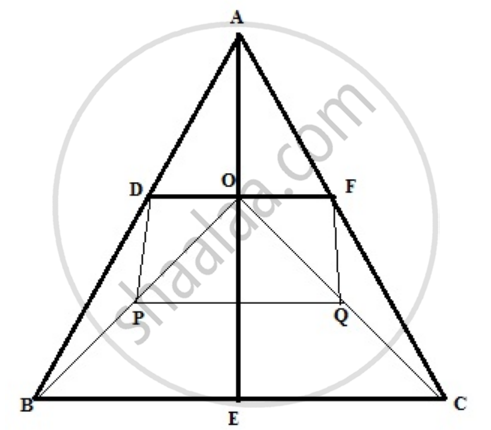
D, E, and F are the mid-points of the sides AB, BC, and CA respectively of ΔABC. AE meets DF at O. P and Q are the mid-points of OB and OC respectively. Prove that DPQF is a parallelogram.

Sum
Advertisements

Solution

Given: △ABC, D, E, F are midpoints of AB, BC, AC respectively. AB and DF meet at O. P and Q are midpoints of OB and OC respectively.
To Prove: DPFQ is a parallelogram.

Proof:
In △ABC,
D is the mid-point of AB and F is the mid-point of AC
Hence, DF ∥ BC and DF = `1/2​`BC        ... (1) (Mid-point theorem)
In △OBC,
P is the mid-point of OB and Q is the mid-point of OC
Hence, PQ ∥ BC and PQ = `1/2`​BC       ... (2) (mid-point theorem)
thus, from (1) and (2)
DF ∥ PQ and DF = PQ                      ....(3)

Now, In △AOB,
D is the mid-point of AB and P is the mid-point of OB
Thus, DP ∥ AE and DP = `1/2`​AE        ....(4) (midpoint theorem)
 Now, In △AOC,
F is the midpoint of AC and Q is the midpoint of OC
Thus, FQ ∥ AE and QF = `1/2`​AE         .....(5) (midpoint theorem)
thus, from (4) and (5)
DP ∥ FQ and DP = FQ                      .....(6)

DPFQ is a parallelogram                 ......(from (3) and (6))
Hence proved.

shaalaa.com
  Is there an error in this question or solution?
Chapter 12: Mid-point and Its Converse [ Including Intercept Theorem] - Exercise 12 (A) [Page 150]

APPEARS IN

Selina Concise Mathematics [English] Class 9 ICSE
Chapter 12 Mid-point and Its Converse [ Including Intercept Theorem]
Exercise 12 (A) | Q 10 | Page 150

RELATED QUESTIONS

ABCD is a quadrilateral in which P, Q, R and S are mid-points of the sides AB, BC, CD and DA (see the given figure). AC is a diagonal. Show that:

  1. SR || AC and SR = `1/2AC`
  2. PQ = SR
  3. PQRS is a parallelogram.


In Fig. below, M, N and P are the mid-points of AB, AC and BC respectively. If MN = 3 cm, NP = 3.5 cm and MP = 2.5 cm, calculate BC, AB and AC.


In triangle ABC, AD is the median and DE, drawn parallel to side BA, meets AC at point E.
Show that BE is also a median.


The side AC of a triangle ABC is produced to point E so that CE = AC. D is the mid-point of BC and ED produced meets AB at F. Lines through D and C are drawn parallel to AB which meet AC at point P and EF at point R respectively.

Prove that:

  1. 3DF = EF
  2. 4CR = AB

In parallelogram PQRS, L is mid-point of side SR and SN is drawn parallel to LQ which meets RQ produced at N and cuts side PQ at M. Prove that M is the mid-point of PQ.


AD is a median of side BC of ABC. E is the midpoint of AD. BE is joined and produced to meet AC at F. Prove that AF: AC = 1 : 3.


In ΔABC, the medians BE and CD are produced to the points P and Q respectively such that BE = EP and CD = DQ. Prove that: A is the mid-point of PQ.


In ∆ABC, AB = 5 cm, BC = 8 cm and CA = 7 cm. If D and E are respectively the mid-points of AB and BC, determine the length of DE.


P, Q, R and S are respectively the mid-points of the sides AB, BC, CD and DA of a quadrilateral ABCD in which AC = BD. Prove that PQRS is a rhombus.


Prove that the line joining the mid-points of the diagonals of a trapezium is parallel to the parallel sides of the trapezium.


Share
Notifications

Englishहिंदीमराठी


      Forgot password?
Use app×