Advertisements
Advertisements
Question
If L and M are the mid-points of AB, and DC respectively of parallelogram ABCD. Prove that segment DL and BM trisect diagonal AC.
Advertisements
Solution
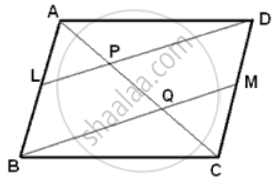
Since L and M are the mid-points of AB and Dc respectively.
`"BL" = (1)/(2)"AB" and "Dm" = (1)/(2)"DC"`....(i)
But ABCD is a parallelogram
Therefore, AB = CD and AB || DC
⇒ BL = DM and BL || Dm ...(from (i))
⇒ BLDM is a parallelogram.
⇒ DL || Dm
⇒ LP || BQ ............(ii)
It is known that the segment drawn through the mid-point of one side of a triangle and parallel to the other side bisects the third side.
In ΔABQ , L is the mid-point of AB and MQ || PD
Therefore, P is mid-point of AQ
Hence, AP = PQ ..........(iii)
Similarly, in ΔCPD, M is the mid-point of CD and LP || BQ
Therefore, Q is mid-point of CP
Hence, PQ = QC ..........(iv)
From (iii) and (iv)
AP = PQ = QC
Therefore, P and Q trisect AC
Thus, DL and BM trisect AC.
APPEARS IN
RELATED QUESTIONS
Show that the line segments joining the mid-points of the opposite sides of a quadrilateral bisect each other.
ABCD is a parallelogram, E and F are the mid-points of AB and CD respectively. GH is any line intersecting AD, EF and BC at G, P and H respectively. Prove that GP = PH.
In triangle ABC, AD is the median and DE, drawn parallel to side BA, meets AC at point E.
Show that BE is also a median.
In ΔABC, AB = 12 cm and AC = 9 cm. If M is the mid-point of AB and a straight line through M parallel to AC cuts BC in N, what is the length of MN?
In ΔABC, P is the mid-point of BC. A line through P and parallel to CA meets AB at point Q, and a line through Q and parallel to BC meets median AP at point R. Prove that: AP = 2AR
In ΔABC, D and E are the midpoints of the sides AB and BC respectively. F is any point on the side AC. Also, EF is parallel to AB. Prove that BFED is a parallelogram.
Remark: Figure is incorrect in Question
D and E are the mid-points of the sides AB and AC of ∆ABC and O is any point on side BC. O is joined to A. If P and Q are the mid-points of OB and OC respectively, then DEQP is ______.
In ∆ABC, AB = 5 cm, BC = 8 cm and CA = 7 cm. If D and E are respectively the mid-points of AB and BC, determine the length of DE.
P, Q, R and S are respectively the mid-points of the sides AB, BC, CD and DA of a quadrilateral ABCD in which AC = BD. Prove that PQRS is a rhombus.
P and Q are the mid-points of the opposite sides AB and CD of a parallelogram ABCD. AQ intersects DP at S and BQ intersects CP at R. Show that PRQS is a parallelogram.
