English

In δAbc, D, E and F Are the Midpoints of Ab, Bc and Ac. If Ae and Df Intersect at G, and M and N Are the Midpoints of Gb and Gc Respectively, Prove that Dmnf is a Parallelogram. - Mathematics

Advertisements
Advertisements

Question

In ΔABC, D, E and F are the midpoints of AB, BC and AC.
If AE and DF intersect at G, and M and N are the midpoints of GB and GC respectively, prove that DMNF is a parallelogram.

Sum
Advertisements

Solution
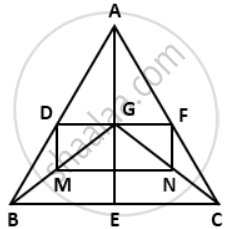

Consider ΔABC and ΔGBC, by mid-point theorem,
2DF = BC and 2MN = BC
⇒ DF = MN      ....(i)
Consider ΔABG and ΔACG, by mid-point theorem,
2DM = AG and 2FN = AG
⇒ DM = FN     ....(ii)
From (i) and (ii), it is clear that DMNF is a parallelogram.

shaalaa.com
  Is there an error in this question or solution?
Chapter 15: Mid-point and Intercept Theorems - Exercise 15.1

APPEARS IN

Frank Mathematics [English] Class 9 ICSE
Chapter 15 Mid-point and Intercept Theorems
Exercise 15.1 | Q 24.2

RELATED QUESTIONS

ABCD is a square E, F, G and H are points on AB, BC, CD and DA respectively, such that AE = BF = CG = DH. Prove that EFGH is a square.


ABCD is a parallelogram, E and F are the mid-points of AB and CD respectively. GH is any line intersecting AD, EF and BC at G, P and H respectively. Prove that GP = PH.


Prove that the figure obtained by joining the mid-points of the adjacent sides of a rectangle is a rhombus.


In triangle ABC, the medians BP and CQ are produced up to points M and N respectively such that BP = PM and CQ = QN. Prove that:

  1. M, A, and N are collinear.
  2. A is the mid-point of MN.

In triangle ABC, D and E are points on side AB such that AD = DE = EB. Through D and E, lines are drawn parallel to BC which meet side AC at points F and G respectively. Through F and G, lines are drawn parallel to AB which meets side BC at points M and N respectively. Prove that: BM = MN = NC.


In triangle ABC; M is mid-point of AB, N is mid-point of AC and D is any point in base BC. Use the intercept Theorem to show that MN bisects AD.


In parallelogram ABCD, P is the mid-point of DC. Q is a point on AC such that CQ = `(1)/(4)"AC"`. PQ produced meets BC at R. Prove that

(i) R is the mid-point of BC, and

(ii) PR = `(1)/(2)"DB"`.


In ΔABC, D, E and F are the midpoints of AB, BC and AC.
Show that AE and DF bisect each other.


In AABC, D and E are two points on the side AB such that AD = DE = EB. Through D and E, lines are drawn parallel to BC which meet the side AC at points F and G respectively. Through F and G, lines are drawn parallel to AB which meet the side BC at points M and N respectively. Prove that BM = MN = NC.


The quadrilateral formed by joining the mid-points of the sides of a quadrilateral PQRS, taken in order, is a rhombus, if ______.


Share
Notifications

Englishहिंदीमराठी


      Forgot password?
Use app×