Advertisements
Advertisements
Question
D, E and F are the mid-points of the sides BC, CA and AB, respectively of an equilateral triangle ABC. Show that ∆DEF is also an equilateral triangle.
Advertisements
Solution
Given in the question, D, E and F are the mid-points of the sides BC, CA and AB, respectively of an equivalent ∆ABC.
To proof that ∆DEF is an equilateral triangle.
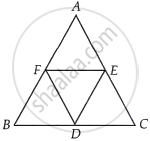
Proof: In ∆ABC, E and F are the mid-points of AC and AB respectively, then EF || BC.
So, EF = `1/2` BC ...(I)
DF || AC, DE || AB
DE = `1/2` AB and FD = `1/2` AC [By mid-point theorem] ...(II)
Now, ∆ABC is an equilateral triangle
AB = BC = CA
`1/2` AB = `1/2` BC = `1/2` CA ...[Dividing by 2 in the above equation]
So, DE = EF = FD ...[From equation (I) and (II)]
Since, all sides of ADEF are equal.
Hence, ∆DEF is an equilateral triangle
Hence proved.
APPEARS IN
RELATED QUESTIONS
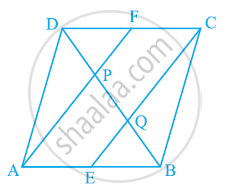
In a parallelogram ABCD, E and F are the mid-points of sides AB and CD respectively (see the given figure). Show that the line segments AF and EC trisect the diagonal BD.
ABCD is a parallelogram, E and F are the mid-points of AB and CD respectively. GH is any line intersecting AD, EF and BC at G, P and H respectively. Prove that GP = PH.
Fill in the blank to make the following statement correct
The triangle formed by joining the mid-points of the sides of an isosceles triangle is
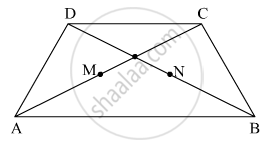
In the adjacent figure, `square`ABCD is a trapezium AB || DC. Points M and N are midpoints of diagonal AC and DB respectively then prove that MN || AB.
In parallelogram ABCD, E is the mid-point of AB and AP is parallel to EC which meets DC at point O and BC produced at P.
Prove that:
(i) BP = 2AD
(ii) O is the mid-point of AP.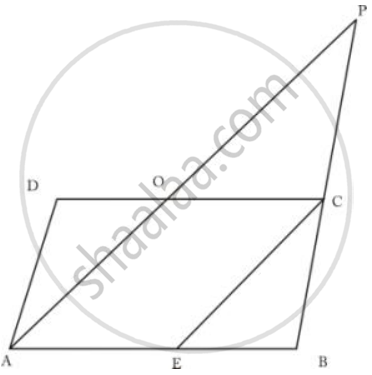
In triangle ABC, D and E are points on side AB such that AD = DE = EB. Through D and E, lines are drawn parallel to BC which meet side AC at points F and G respectively. Through F and G, lines are drawn parallel to AB which meets side BC at points M and N respectively. Prove that: BM = MN = NC.
The diagonals of a quadrilateral intersect each other at right angle. Prove that the figure obtained by joining the mid-points of the adjacent sides of the quadrilateral is a rectangle.
In the given figure, PS = 3RS. M is the midpoint of QR. If TR || MN || QP, then prove that: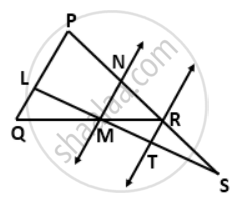
RT = `(1)/(3)"PQ"`
The quadrilateral formed by joining the mid-points of the sides of a quadrilateral PQRS, taken in order, is a rectangle, if ______.
P, Q, R and S are respectively the mid-points of the sides AB, BC, CD and DA of a quadrilateral ABCD such that AC ⊥ BD. Prove that PQRS is a rectangle.
