Advertisements
Advertisements
प्रश्न
D, E and F are the mid-points of the sides BC, CA and AB, respectively of an equilateral triangle ABC. Show that ∆DEF is also an equilateral triangle.
Advertisements
उत्तर
Given in the question, D, E and F are the mid-points of the sides BC, CA and AB, respectively of an equivalent ∆ABC.
To proof that ∆DEF is an equilateral triangle.
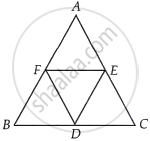
Proof: In ∆ABC, E and F are the mid-points of AC and AB respectively, then EF || BC.
So, EF = `1/2` BC ...(I)
DF || AC, DE || AB
DE = `1/2` AB and FD = `1/2` AC [By mid-point theorem] ...(II)
Now, ∆ABC is an equilateral triangle
AB = BC = CA
`1/2` AB = `1/2` BC = `1/2` CA ...[Dividing by 2 in the above equation]
So, DE = EF = FD ...[From equation (I) and (II)]
Since, all sides of ADEF are equal.
Hence, ∆DEF is an equilateral triangle
Hence proved.
APPEARS IN
संबंधित प्रश्न
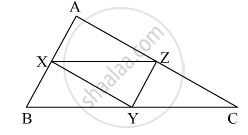
In the given figure, points X, Y, Z are the midpoints of side AB, side BC and side AC of ΔABC respectively. AB = 5 cm, AC = 9 cm and BC = 11 cm. Find the length of XY, YZ, XZ.
In triangle ABC, AD is the median and DE, drawn parallel to side BA, meets AC at point E.
Show that BE is also a median.
In a triangle ABC, AD is a median and E is mid-point of median AD. A line through B and E meets AC at point F.
Prove that: AC = 3AF.
D, E, and F are the mid-points of the sides AB, BC, and CA respectively of ΔABC. AE meets DF at O. P and Q are the mid-points of OB and OC respectively. Prove that DPQF is a parallelogram.
In Δ ABC, AD is the median and DE is parallel to BA, where E is a point in AC. Prove that BE is also a median.
In parallelogram ABCD, E is the mid-point of AB and AP is parallel to EC which meets DC at point O and BC produced at P.
Prove that:
(i) BP = 2AD
(ii) O is the mid-point of AP.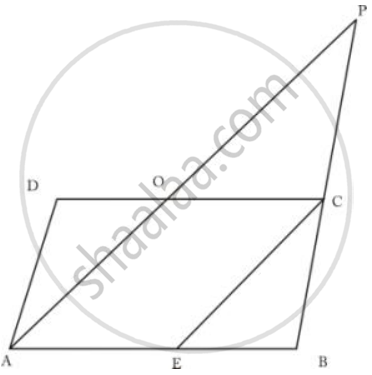
In a parallelogram ABCD, M is the mid-point AC. X and Y are the points on AB and DC respectively such that AX = CY. Prove that:
(i) Triangle AXM is congruent to triangle CYM, and
(ii) XMY is a straight line.
The diagonals AC and BD of a quadrilateral ABCD intersect at right angles. Prove that the quadrilateral formed by joining the midpoints of quadrilateral ABCD is a rectangle.
In ΔABC, D and E are the midpoints of the sides AB and AC respectively. F is any point on the side BC. If DE intersects AF at P show that DP = PE.
P, Q, R and S are respectively the mid-points of sides AB, BC, CD and DA of quadrilateral ABCD in which AC = BD and AC ⊥ BD. Prove that PQRS is a square.
