Advertisements
Advertisements
प्रश्न
P, Q, R and S are respectively the mid-points of sides AB, BC, CD and DA of quadrilateral ABCD in which AC = BD and AC ⊥ BD. Prove that PQRS is a square.
Advertisements
उत्तर
Given: In quadrilateral ABCD, P, Q, R and S are the mid-points of the sides AB, BC, CD and DA, respectively.
Also, AC = BD and AC ⊥ BD.
To prove: PQRS is a square.
Proof: Now, in ΔADC, S and R are the mid-points of the sides AD and DC respectively, then by mid-point theorem,
SR || AC and SR = `1/2` AC ...(i)
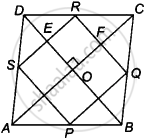
In ΔABC, P and Q are the mid-points of AB and BC, then by mid-point theorem,
PQ || AC and PQ = `1/2` AC ...(ii)
From equations (i) and (ii),
PQ || SR and PQ = SR = `1/2` AC ...(iii)
Similarly, in ΔABD, by mid-point theorem,
SP || BD and SP = `1/2` BD = `1/2` AC [Given, AC = BD] ...(iv)
And ΔBCD, by mid-point theorem,
RQ || BD and RQ = `1/2` BD = `1/2` AC [Given, BD = AC] ...(v)
From equations (iv) and (v),
SP = RQ = `1/2` AC ...(vi)
From equations (iii) and (vi),
PQ = SR = SP = RQ
Thus, all four sides are equal.
Now, in quadrilateral OERF,
OE || FR and OF || ER
∴ ∠EOF = ∠ERF = 90° ...[∵ AC ⊥ DB ⇒ ∠DOC = ∠EOF = 90° as opposite angles of a parallelogram]
∴ ∠QRS = 90°
Similarly, ∠RQS = 90°
So, PQRS is a square.
Hence proved.
APPEARS IN
संबंधित प्रश्न
ABCD is a rhombus and P, Q, R and S are the mid-points of the sides AB, BC, CD and DA respectively. Show that the quadrilateral PQRS is a rectangle.
In a ∆ABC, D, E and F are, respectively, the mid-points of BC, CA and AB. If the lengths of side AB, BC and CA are 7 cm, 8 cm and 9 cm, respectively, find the perimeter of ∆DEF.
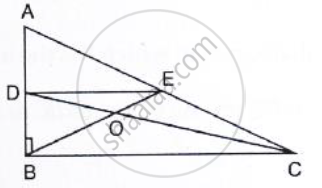
In Fig. below, triangle ABC is right-angled at B. Given that AB = 9 cm, AC = 15 cm and D,
E are the mid-points of the sides AB and AC respectively, calculate
(i) The length of BC (ii) The area of ΔADE.
Fill in the blank to make the following statement correct:
The triangle formed by joining the mid-points of the sides of a right triangle is
In triangle ABC, M is mid-point of AB and a straight line through M and parallel to BC cuts AC in N. Find the lengths of AN and MN if Bc = 7 cm and Ac = 5 cm.
The side AC of a triangle ABC is produced to point E so that CE = AC. D is the mid-point of BC and ED produced meets AB at F. Lines through D and C are drawn parallel to AB which meet AC at point P and EF at point R respectively.
Prove that:
- 3DF = EF
- 4CR = AB
In trapezium ABCD, sides AB and DC are parallel to each other. E is mid-point of AD and F is mid-point of BC.
Prove that: AB + DC = 2EF.
In ΔABC, P is the mid-point of BC. A line through P and parallel to CA meets AB at point Q, and a line through Q and parallel to BC meets median AP at point R. Prove that: AP = 2AR
The diagonals AC and BD of a quadrilateral ABCD intersect at right angles. Prove that the quadrilateral formed by joining the midpoints of quadrilateral ABCD is a rectangle.
D and E are the mid-points of the sides AB and AC of ∆ABC and O is any point on side BC. O is joined to A. If P and Q are the mid-points of OB and OC respectively, then DEQP is ______.
