Advertisements
Advertisements
प्रश्न
Show that the quadrilateral formed by joining the mid-points of the consecutive sides of a square is also a square.
Advertisements
उत्तर
Given: In a square ABCD, P, Q, R and S are the mid-points of AB, BC, CD and DA, respectively.
To show: PQRS is a square.
Construction: Join AC and BD.
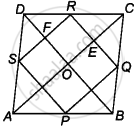
Proof: Since, ABCD is a square.
∴ AB = BC = CD = AD
Also, P, Q, R and S are the mid-points of AB, BC, CD and DA, respectively.
Then, in ΔADC, SR || AC
And SR = `1/2`AC [By mid-point theorem] ...(i)
In ΔABC, PQ || AC
And PQ = `1/2`AC ...(ii)
From equations (i) and (ii),
SR || PQ and SR = PQ = `1/2`AC ...(iii)
Similarly, SP || BD and BD || RQ
∴ SP || RQ and SP = `1/2`BD
And RQ = `1/2`BD
∴ SP = RQ = `1/2`BD
Since, diagonals of a square bisect each other at right angle.
∴ AC = BD
⇒ SP = RQ = `1/2`AC ...(iv)
From equations (iii) and (iv),
SR = PQ = SP = RQ ...[All side are equal]
Now, in quadrilateral OERF,
OE || FR and OF || ER
∴ ∠EOF = ∠ERF = 90°
Hence, PQRS is a square.
Hence proved.
APPEARS IN
संबंधित प्रश्न
ABCD is a rhombus and P, Q, R and S are the mid-points of the sides AB, BC, CD and DA respectively. Show that the quadrilateral PQRS is a rectangle.
In a ΔABC, E and F are the mid-points of AC and AB respectively. The altitude AP to BC
intersects FE at Q. Prove that AQ = QP.
In a ΔABC, BM and CN are perpendiculars from B and C respectively on any line passing
through A. If L is the mid-point of BC, prove that ML = NL.
BM and CN are perpendiculars to a line passing through the vertex A of a triangle ABC. If
L is the mid-point of BC, prove that LM = LN.
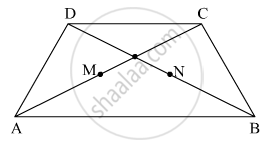
In the adjacent figure, `square`ABCD is a trapezium AB || DC. Points M and N are midpoints of diagonal AC and DB respectively then prove that MN || AB.
D, E, and F are the mid-points of the sides AB, BC and CA of an isosceles ΔABC in which AB = BC.
Prove that ΔDEF is also isosceles.
In a triangle ABC, AD is a median and E is mid-point of median AD. A line through B and E meets AC at point F.
Prove that: AC = 3AF.
In ΔABC, P is the mid-point of BC. A line through P and parallel to CA meets AB at point Q, and a line through Q and parallel to BC meets median AP at point R. Prove that: AP = 2AR
ABCD is a parallelogram.E is the mid-point of CD and P is a point on AC such that PC = `(1)/(4)"AC"`. EP produced meets BC at F. Prove that: 2EF = BD.
In AABC, D and E are two points on the side AB such that AD = DE = EB. Through D and E, lines are drawn parallel to BC which meet the side AC at points F and G respectively. Through F and G, lines are drawn parallel to AB which meet the side BC at points M and N respectively. Prove that BM = MN = NC.