मराठी

In Trapezium Abcd, Ab is Parallel to Dc; P and Q Are the Mid-points of Ad and Bc Respectively. Bp Produced Meets Cd Produced at Point E. Prove That: (I) Point P Bisects Be, - Mathematics

Advertisements
Advertisements

प्रश्न

In trapezium ABCD, AB is parallel to DC; P and Q are the mid-points of AD and BC respectively. BP produced meets CD produced at point E.

Prove that:

  1. Point P bisects BE,
  2. PQ is parallel to AB.
बेरीज
Advertisements

उत्तर

The required figure is shown below
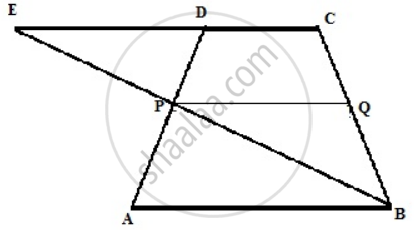
(i) From ΔPED and ΔABP,

PD = AP               ...[P is the mid-point of AD]

∠DPE = ∠APB      ....[Opposite angle]

∠PED = ∠PBA      ...[AB || CE]

∴ ΔPED ≅ ΔABP   ...[ASA postulate]

∴ EP = BP

(ii) In Δ ECB,

P is a mid point of BE and

Q is a mid point of BC

∴ PQ || CE   ...(i)  (by mid point theorem)

and CE || AB   ... (ii)

From equation (i) and (ii)

PQ || AB

Hence proved.

shaalaa.com
  या प्रश्नात किंवा उत्तरात काही त्रुटी आहे का?
पाठ 12: Mid-point and Its Converse [ Including Intercept Theorem] - Exercise 12 (A) [पृष्ठ १५१]

APPEARS IN

सेलिना Concise Mathematics [English] Class 9 ICSE
पाठ 12 Mid-point and Its Converse [ Including Intercept Theorem]
Exercise 12 (A) | Q 12 | पृष्ठ १५१

संबंधित प्रश्‍न

In Δ ABC, AD is the median and DE is parallel to BA, where E is a point in AC. Prove that BE is also a median.


In the figure, give below, 2AD = AB, P is mid-point of AB, Q is mid-point of DR and PR // BS. Prove that:
(i) AQ // BS
(ii) DS = 3 Rs.


In ΔABC, D, E, F are the midpoints of BC, CA and AB respectively. Find ∠FDB if ∠ACB = 115°.


Prove that the straight lines joining the mid-points of the opposite sides of a quadrilateral bisect each other.


In parallelogram ABCD, P is the mid-point of DC. Q is a point on AC such that CQ = `(1)/(4)"AC"`. PQ produced meets BC at R. Prove that

(i) R is the mid-point of BC, and

(ii) PR = `(1)/(2)"DB"`.


In the given figure, ABCD is a trapezium. P and Q are the midpoints of non-parallel side AD and BC respectively. Find: PQ, if AB = 12 cm and DC = 10 cm.


ΔABC is an isosceles triangle with AB = AC. D, E and F are the mid-points of BC, AB and AC respectively. Prove that the line segment AD is perpendicular to EF and is bisected by it.


In a parallelogram ABCD, E and F are the midpoints of the sides AB and CD respectively. The line segments AF and BF meet the line segments DE and CE at points G and H respectively Prove that: ΔGEA ≅ ΔGFD


In the given figure, T is the midpoint of QR. Side PR of ΔPQR is extended to S such that R divides PS in the ratio 2:1. TV and WR are drawn parallel to PQ. Prove that T divides SU in the ratio 2:1 and WR = `(1)/(4)"PQ"`.


The quadrilateral formed by joining the mid-points of the sides of a quadrilateral PQRS, taken in order, is a rectangle, if ______.


Share
Notifications

Englishहिंदीमराठी


      Forgot password?
Use app×