Advertisements
Advertisements
प्रश्न
In trapezium ABCD, AB is parallel to DC; P and Q are the mid-points of AD and BC respectively. BP produced meets CD produced at point E.
Prove that:
- Point P bisects BE,
- PQ is parallel to AB.
Advertisements
उत्तर
The required figure is shown below
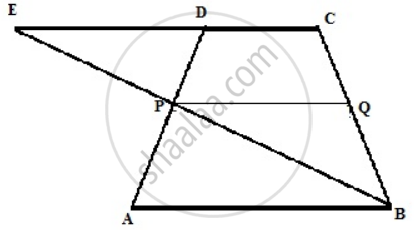
(i) From ΔPED and ΔABP,
PD = AP ...[P is the mid-point of AD]
∠DPE = ∠APB ....[Opposite angle]
∠PED = ∠PBA ...[AB || CE]
∴ ΔPED ≅ ΔABP ...[ASA postulate]
∴ EP = BP
(ii) In Δ ECB,
P is a mid point of BE and
Q is a mid point of BC
∴ PQ || CE ...(i) (by mid point theorem)
and CE || AB ... (ii)
From equation (i) and (ii)
PQ || AB
Hence proved.
APPEARS IN
संबंधित प्रश्न
In a triangle, P, Q and R are the mid-points of sides BC, CA and AB respectively. If AC =
21 cm, BC = 29 cm and AB = 30 cm, find the perimeter of the quadrilateral ARPQ.
In the given figure, seg PD is a median of ΔPQR. Point T is the mid point of seg PD. Produced QT intersects PR at M. Show that `"PM"/"PR" = 1/3`.
[Hint: DN || QM]

In trapezium ABCD, sides AB and DC are parallel to each other. E is mid-point of AD and F is mid-point of BC.
Prove that: AB + DC = 2EF.
In the given figure, AD and CE are medians and DF // CE.
Prove that: FB = `1/4` AB.
Prove that the figure obtained by joining the mid-points of the adjacent sides of a rectangle is a rhombus.
ABCD is a parallelogram.E is the mid-point of CD and P is a point on AC such that PC = `(1)/(4)"AC"`. EP produced meets BC at F. Prove that: 2EF = BD.
ABCD is a kite in which BC = CD, AB = AD. E, F and G are the mid-points of CD, BC and AB respectively. Prove that: ∠EFG = 90°
In ΔABC, the medians BE and CD are produced to the points P and Q respectively such that BE = EP and CD = DQ. Prove that: A is the mid-point of PQ.
The quadrilateral formed by joining the mid-points of the sides of a quadrilateral PQRS, taken in order, is a rhombus, if ______.
The figure obtained by joining the mid-points of the sides of a rhombus, taken in order, is ______.
